Hello, everybody! Do you know the song “Ame no Midosuji” (雨の御堂筋) by the famous singer that came from the country of Taiwan called Ouyang Fei Fei (歐陽菲菲)? It’s about a woman who is searching for her lover in a rainy night. She went on looking for him but in despair she found nobody, and just me do with her memories of him. We have all searched for something in our lives, but sometimes we never get to find some of them. Unlike Ouyang Fei Fei, I have found something that I was looking for, and it came to me as a beautiful surprise. It’s one of the rarest Nikkors ever made and I will show you what I found today.
Introduction:
The Cine-Zoom-Nikkor 17-70mm f/2.2 is one of the few Cine-Zoom Nikkors that’s seen in catalogs, it’s still a mystery even to knowledgeable historians and collectors. Nobody knew when it was made and for how long but I suspect is that it was sold as early as 1959 or 1963. Nobody knew when production stopped so I cannot even speculate. It’s a very mysterious lens and I will try my best to give you the most up-to-date information I could find, including some sample photos and a complete teardown of this lens.
Its construction and all-metal build are outstanding, definitely the best of all Cine-Nikkors. It’s also heavy, so I get nervous just thinking about how much stress the threads of the mount must endure when this is fitted to a movie camera and used for a long span of time.
Hello, everybody! I just bought a DNA testing kit, you know, the one that’s hip with the kids these days. I bought it because I wanted to know what are my health risks because I’m not young anymore. I did not get one because I want to avoid accidentally banging my relatives like what some people actually think and do for themselves. I’m also curious to know if I have relatives around the world, maybe I will find an uncle living nearby that I have never ever heard of, isn’t that exciting? Speaking of finding secret relatives and genealogy, I would like to share with you a “secret relative” of the Nikkor 135/3.5 family. It is not well known so it might as well be an urban legend for some people but we will know everything about it here in this article.
Introduction:
This adapter for Nikkor-Q•C 13.5cm f/3.5 will enable you to use the front barrel of the lens and mount it to any camera that uses the Nikon F-mount. It was made for a short time to coincide with the release of the legendary Nikon F. Not a lot of people knew about it and it’s only ever mentioned in the catalogs. It isn’t really a proper “lens” so to speak because it was ever only sold as a separate item as far as I know.
It is much shorter compared to its rangefinder cousins. It’s because the F-mount requires a longer flange distance in order to stay clear of the flapping mirror. While the construction is all-metal, the adapter feels somewhat “cheap” because the bayonet mount is part of the lower barrel. While it keeps things simple, it gives the impression of cheapness like what I have just mentioned.
Hello, everybody! Have you ever been duped into thinking that something might be fake? You pass it and regret later after finding out that it’s probably the best bargain you could ever find. It has happened a lot with some of my friends who collect expensive watches. It has happened to me several times before, but I am more lucky than stupid so I am usually blessed with good deals. Today, I will show you one such lucky find, a real find of a lifetime. In all my years hunting for rare items I have ever only seen and touched 2 of these. Please read the whole article to know why this is so special.
Introduction:
The Nikkor-Q.C 13.5cm f/3.5 featured in this article is a special one, it is one of the very few existing lenses that Nikon made that came with an Exakta-mount. Only a few people have knowledge of its existence and even fewer people have ever seen one in person. I am extremely lucky to own such a rare oddity. Nobody knew exactly how many of these were made, we can only date them by their serial numbers. My example is probably from 1954.
Compared to the usual ones that came with a rangefinder mount, this one is quite short. It has to be since the Exakta is an SLR, complete with a flapping mirror. You may easily assume that this was modified using a talented specialist shop at first glance but the quality is so consistent that it can only come from Nikon. I almost dismissed it when I first saw this, singing it’s a fake.
Hello, everybody! Because of the generous support that I got from all of you, I am motivated to finish this series earlier than scheduled. I’m not saying that I am like a jukebox that will only play whenever a coin is inserted, but a little bit of donation makes me feel that my contribution to the community is welcomed. It has been many years since I have started this website and this is one of the few instances where everyone seems to so eager to see the final part of a series. Your prayers have been answered, this article will be the best resource for this camera around in the internet unless someone else will be able to write something better. If you’re content creator, please don’t rip my content off. If you must, at least help advertise for me and leave me a little tip, that will be very much appreciated. It’s fair for me to ask.
Introduction:
The Voigtländer Bessa R is a quirky camera, but it’s very popular. There’s many people who have had the bad luck of owning lemons just because of how it was constructed. In this case, popularity does not mean reliability. You will know why I made the statement in this article. Despite having a bad reputation for its reliability, some people have been lucky with their cameras so it’s not entirely the camera’s fault. It’s still a great camera, all you need to do is inspect the camera very well before buying one and ask for a warranty. That should give you enough time to run a few rolls through it.
I am somewhat disappointed at the amount of plastics used within the camera. I could accept it having a plastic exterior but seeing plastic used in some of the important parts inside the camera turned me off. It is ironic because it’s not the plastic parts that will give in first, what some of the metal parts.
Hello, everybody! Do you believe in curses? Some folks believe that items can be cursed, it can come from the previous owner or just a stroke bad luck. You’ll sometimes wonder why things are always in a messed up state or why they’re always broken. The good thing is, curses can be lifted by good karma, faith or the patience of a good healer. Today, I will show you a cursed camera. It has been featured on the internet for a couple of years now, with the owner desperate to find a way of lifting the curse. It’s destiny that brought me and the camera together. Do you think I have enough good karma to lift the curse of the evil jammed shutter? I have been saving cameras and lenses for years, along with presenting you the best articles you can find on the internet. Let’s see if all that goodness will change the fate of this poor thing.
Introduction:
The Voigtländer Bessa R was sold from 2000 up to 2004, it was preceded by a minimalistic model called the Voigtländer Bessa L which doesn’t come with a viewfinder nor a rangefinder. It’s a brave gamble by a small company relative to the giants of the time called Nikon and Canon. The company is named Cosina, a company with a long history and experience. They dared to sell a concept that went against what the market was used to, the effort resulted in an instant classic that spawned a whole line of cameras. Many people are attracted to these because they offer something unique and that not a lot of brands give. It’s still very popular these days and the price has shot up due to the hype from influencers. I will show you if this hype is deserved or not in this series, you will be the judge of it.
This is the most modern LTM camera you can ever buy. It has a lot of modern conveniences which helps in simplifying the process of taking great photos. It is a great “Sunday camera” for leisurely taking photos at a park or the streets. It offers the best in terms of comfort of all the LTM cameras I have ever used.
Hello, everybody! I’ve got this crush on Kobayashi Akiko (小林明子) when she was younger, her face was beautiful and she is certainly very graceful specially when singing her hit “恋に落ちて” or “Fall in Love” in English. It’s a song about being in love from an innocent woman’s perspective. I see het at that point in her life as the epitome of femininity, beauty and a lot of other things that I associate a perfect woman to be. She’s now a certified “auntie”, not someone I would fancy for now but I still respect her. It seems that she as aged as gracefully as her hit which has been covered numerous times and by different singers in various languages. Today, I will show you something that’s equally graceful and it has aged well, too.
Introduction:
The Nikkor-Q•C 13.5cm f/3.5 had a long run, with production running from 1951–1962. The one we have in this article was made in the final patches so it’s close to the last one produced. The reason why we are interested in this version is the different style of its barrel. It now looks more modern and some parts are now made of aluminum alloy instead of the heavy brass that we are all used to seeing. This change came about around the latter half of the 1950s, but exact dates are unknown. Of all the known versions, this is the least desirable so it’s also the cheapest one you can get.
The barrel looks much sleeker and the black paint makes it look smart. Nothing much has changed when I use it except for feeling a bit lighter in my hands. It’s very beautiful with all those colorful markings. I must also say that the black paint helps contrast the colors much better. The previous version is also black but I don’t recall that having multicolored markings, they are just white numbers. This one makes it a lot easier to read everything and it also comes in both standard and metric.
Hello, everybody! Do you have a vice that you have been staying away from with the best of your ability? I am sure but we all do. Is it smoking, alcohol or pornography? Or is it something more benign like buying cameras and lenses? It is very hard to keep the urge, the longer you keep it the stronger the climax is. This is how I felt when I made my latest purchase, it’s something that I have always wanted but the price is not something that I can easily afford. I was lucky that I found one for a reasonable price, it’s not cheap but it is fair. When I finally got it, I felt an overwhelming release, as if something that I have been keeping in for many years suddenly came out. I have nothing more to hide so I will show you my latest yo-yo.
Introduction:
The W-Nikkor•C 2.5cm f/4 is the smallest rangefinder Nikkor that you will ever find, that is if you measure it from the lens mount of the camera. As a W-Nikkor, it fills a unique place in the catalog for a super-wide lens. During that time, a 35mm lens is already considered wide and 28mm is the entry point to the really-wide category. It was made from 1953 up to an undetermined date so we assume that production lasted until the final days of the Nikon rangefinder era. There are only 2 variations for the Nikon S-mount, earlier ones come in shiny chrome like you see here while later ones are painted black. These were also made in Leica M39 screw mounts, too. Just like everything Leica, they will cost you more than a kidney to acquire.
It is very compact, it feels dense in your hand. The build quality is typical for its time, which means this is a very well-made product. There’s nothing much to manipulate with this lens as it lacks a focusing ring, this is one of the defining traits of this lens. It is truly unique in many ways.
Hello, everybody! Do you know what’s a “chastity belt“? They are metal or leather underwear for women in the Middle Ages up until recently In some cultures. They ensure that the wearer is celibate while these special panties are on. Not so common is the male counterpart, it forces a religious person to be celibate. Why are we talking about such unusual topics? Our star today has some kind of a “chastity belt”, too! It’s quite a surprise because I have modified it to protect something precious. know more about it hear in this article and read until the end.
Introduction:
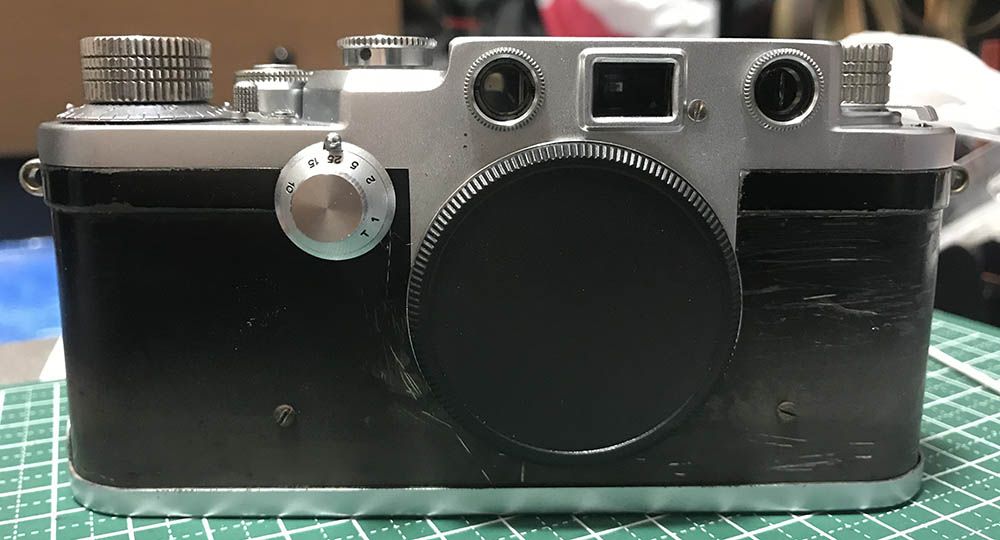
We ended part 1 with the removal of the outer casing, in this part we’ll see how the internal mechanisms can be dismantled. If you have worked on similar cameras before then they should come as no surprise to you because they’re very similar. Some things may be a little bit different but they should not matter at all in the grand scheme of things.
I got to this point by the end of this article, waiting for the replacement leatherette from the amazing and reliable Asahi Aki, who gave me what I exactly needed. His kits are exquisite and reasonably priced, he is the best guy in the business, I highly recommend his services and products.
Hello, everybody! Do you believe in the “Leica glow“? It is a legend taught by the “Leica church” which has been described as something ethereal, akin to angel dust. Some will say that it was done intentionally but I see it as just an excuse to justify the high cost of a poorly coated optic, if at all. It’s like a ghost, it is there or not depending on what you believe in. Today, I’ll show you something that exhibits something similar. I do not dare say that it’s the same thing but I will let you decide the matter for yourself. Believe it, or not?
Introduction:
The Nikkor 5cm f/2.8 was produced for a very short time, somewhere between 1936–1940 about the same time as the Seiki Kogaku Kwanon and Seiki Kogaku S. Seiki Kogaku (Canon) could not manufacturer their own lenses at that time so Nippon Kogaku (Nikon) had to do that for them. It is one of the first Nikkors for the consumer market because at that time, Nikon concentrated its production for the Japanese military. It did not stay for long probably because the faster Nikkor 5cm f/2 made more sense. Both were only made to fit the unique bayonet mount (by Nikon) for the earliest Seiki Kogaku cameras mentioned before. This mount has no official name to my knowledge so people call it the Hansa-mount, or Seiki-mount for me.
The whole thing is made of metal apart from the glass and the felt lining at the mount. It is heavy since everything is mostly made from brass. The workmanship is better than many Nikkors that were made in the years right after the end of the war, or the MIOJ (Made in Occupied Japan) series. The fit and finish is nice even to this day and even after being stored poorly for decades under undesirable conditions.
Hello, everybody! I sometimes wonder why Nippon Kogaku manufactured the bayonet mount and maybe even the rangefinder mechanism of the very early Seiki Kogaku cameras. Is it because Nippon Kogaku is a specialist and the best optics company in Japan at that time? Or perhaps Seiki Kogaku did not know how to do them properly because they lack experience in optics? If it’s just optics then why didn’t they make the helicoid and the rest of the bayonet mount themselves? These are the questions that we’ll never know the answers to, but we will definitely examine every part of the Seiki KogakuS here in this series.
Introduction:
Why is this camera called the Seiki Kogaku S? That S used to mean “最新” or latest model, it was changed to stand for the name “Standard“. Some people even believe that it stood for “Slow” because it has a slow speeds compared to the previous model (Seiki Kogaku Hansa) which has none. I do not think the name is that important in this context because we’re more interested in restoring this camera. I only mentioned it because some people may be curious about what the name means.
It is interesting to note that there’s a hole at the center of the pressure plate and in the shell underneath this. That hole is plugged with a disc that you can unscrew so you will have direct vision through the hole for peeping. This is used for adjusting the flange distance of the camera. You insert a frosted paper inside the camera as you would do with a sheet of film and then you begin adjusting. I’m very sure that they use something made of glass instead of frosted paper for the adjustment at the factory.
Help support this site by donating to richardHaw888@gmail.com over at Paypal! If you want to buy me a beer or a roll of film then that would be great,too!




 Richard Haw's Classic Nikon Repair and Review