Hello, everybody! Do you know Miyako Harumi (都 はるみ)? She is a celebrated Japanese folk singer who is popular from the 1960s up until today, she is an inspiration to many generations of singers. Her voice is very powerful and distinctive, exhibiting a wide range, it’s something that’s hard to match even to today. I think she is one of the best folk singers Japan has ever produced. Another striking thing about her is how small she is, despite her being tiny, she is able to channel such a powerful voice, something unexpected. I will show you something today that is tiny, and like Miyako Harumi, its performance is nothing small. Hear more about it in this article and see if you will agree with my assumption.
Introduction:
The Cine-Nikkor 50mm f/1.8 is a lens that was made for the 16mm format, I dare say that it’s probably the most popular of the C-Mount Nikkors due to its abundance in the used market. I don’t know when it was made but I can speculate that it ran from the late 1950s up until the 1970s judging from boxes and other things such as brochures and literature. There’s not a lot of information about Cine-Nikkors that can be found on the web, even the exhibit at the Nikon Museum about the Cine-Nikkors did not have everything that I need to date these little gems.
The barrel has the standard Cine-Nikkor design but it’s a bit shorter compared to some of its peers. It is a very well-made lens, the all-metal barrel is durable, the orientation of the mount can even be adjusted so you can see the engravings properly, just push the thread in and turn it to match your preference.
Hello, everybody! Do you feel like there are days when everything you see looks yellowish? I don’t, but I have heard of some people who do. Apparently, some people who suffer from internal disease will see things with a slight yellowish tint, as if wearing a pair of yellow lenses. It can be fascinating but it isn’t a joke or something to look forward to. The good thing is you don’t need to have this condition in order to see the world differently, I will show you something that will help give your photos a touch of yellow. It’s interesting so please read the whole article and click on the photos see what I mean.
Introduction:
The Reflx Lab 100 is a film that’s respooled by a company in China, which I try my best not to support if I can help it but I have already spent my money so here it goes. The good thing is at least they tell us what film they use, in this case it’s the Kodak Vision3 50D. Most companies that respool film won’t even tell you which stock their products came from so this is something good for the community.
It comes inside a metal canister which you can use to store weed or anything else, I don’t think that it’s necessary because it just adds to the cost of this product. The price is not so bad, in fact, it costs much cheaper compared to its rival.
Hello, everybody! Inflation is a big problem in this socialist country, the leaders have ran this country into the ground. It is affecting everyone, people skip meals just to get by because the price of basic groceries and shot up the roof. When fuel and food prices go up, everything else follows. In these trying times, it is best to be frugal. This hobby isn’t cheap and those who say that shooting film is cheaper than shooting a digital camera don’t know about economics. The good thing is there are always cheaper alternatives, you just need to know what to look for and where. In my case, it came as a surprise, more like an accident. It’s interesting and I’d like to share my findings with you. I’m not a “cheap-Charlie” but I welcome any form of savings, that’s just called being practical.
Introduction:
The Reflx Lab 800 is a film that’s respooled and marketed by a Chinese company in Shenzhen, I did not know about it at first but doing a bit of research revealed what I need to know about this company. It’s refreshing to see some newcomers into the market and it is interesting to know more about what they have to offer to the community. For this company, it’s cheaper versions of the products made by more established brands. They’re not entirely knock-offs but they have benefited from other people’s idea. In this case, it’s repackaged Kodak VISION3 500T Color cinema film. While the idea to do this is not theirs, I will applaud them for being transparent at least and state which stock their product came from.
It comes inside a metal canister which you can use to store weed or anything else, I don’t think that it’s necessary because it just adds to the cost of this product. The price is not so bad, in fact, it costs much cheaper compared to its rival.
Hello, everybody! Do you like watching “Japanese prawn” or “車海老”? I used to be an aquarist and these creatures are amazing to watch, they’re big and their colors are amazing. Needless to say, they are tasty. I know of a few varieties for preparation but my favorite is “tempura”. There are 3 main ways to prepare the meat, tempura, sushi and salt-baked, of the 3 major ways, the most popular one is tempura by far. Today, I will show you something that is also “big”, it also comes in 3 major variations. And just like the Japanese prawns, this is also something that you do not encounter everyday because it’s special, even expensive! It is also something to celebrate, stay a while and listen to my story.
Introduction:
The Nikkor-N 5cm f/1.1 was produced from 1956 to somewhere around 1959. It was Nikon’s fastest lens, only to be replaced by the recent Nikkor Z 58mm f/0.95 S Noct after more than a half-a-century’s time. It’s considered to be a breakthrough for the company in terms of lens design and mechanical engineering. Its reputation is such that it has earned a following over the years because for such a long time, Nikon didn’t make a true successor for it, with the next-fastest one being the Nikkor 50mm f/1.2 Ai. Sure, Nikon made the Nikkor-S 55mm f/1.2 Auto but it isn’t a 50mm “normal” lens, so most people do not consider that lens as a true successor. While the Nikkor-N 5cm f/1.1 was hailed as a breakthrough, it was merely a response to the world’s then fastest lens – the Zunow 5cm f/1.1 which came out a few years earlier. That lens sent a big message throughout the optics industry, and of course, Nikon had to respond.
We are going to look at the “external-mount” version of this lens, it has 3 known variants which we’ll talk about later. The barrel’s engineering is surprisingly modern, it has a focusing unit and the front barrel will not turn as you focus, unlike the internal-mount 50mmNikkors. The aperture ring is at the front, closer to the tip of the lens, while the focusing ring is situated at the center. The aperture ring is not evenly-spaced, a typical limitation of many older lenses. The attachment ring is 62mm, it’s best to only use Nikon’s filters of the same period because of the threads and position of the glass, using something else may scratch its front element since it’s too bulbous.
Hello, everybody! Do you know what is a “Billiken“? It’s The unofficial mascot of Osaka but with American roots, it was said that rubbing the feet will bring you good luck. His devious smile makes him appear a bit naughty and mischievous, but that’s just how he is. He said to be the god of “things as they ought to be“, helping you accept the trials of life in a more light manner. Today, I will show you a lens that will help you accept things as they are, it has its imperfections but they’re not so bad as to the degrade the photos you take, it’s kind of Zen-like shooting with this lens using a film camera. Read the whole article to know what this lens is all about.
Introduction:
The W-Nikkor•C 3.5cm f/2.5 came in two distinct mounts, one for the native Nikon S-mount and another for the Leica Thread Mount, this article will showcase the latter. This lens family was made from 1952 up to 1959, while the Nikon S-mount version was made with multiple variations, the Leica fit one came in two minor variations, one with a silver focusing ring and another with a black focusing ring, that’s it. These are highly collectible not only because of their importance in Nikon’s history but also due to their practicality. I think this is the most practical W-Nikkor, it’s really good for many things. It’s a very popular lens so these are not rare at all.
The barrel is all-metal, made from top-quality brass, that makes the lens heavy despite being compact. It’s not a big lens at all and you can hide it inside your palm. The engravings are helpful and clear, making the work of focusing much easier.
Hello, everybody! Do you remember Ziggy? He is a popular cartoon character from several decades ago, with a toy line that many people collect. He came in various costumes, making Ziggy fans collect them all. It’s a harmless hobby with many collectors and you will be surprised at how much these toys can go for. I used to collect them, too. Remembering Ziggy takes me back to my younger years where things are much simpler and happiness came in smaller packages. Today, I’ll show you something that’s just as collectible, I can say that it’s exciting to complete the collection, but unlike Ziggy toys, it’s a hobby for the truly devout followers of the way of Nikkor.
Introduction:
The Nikkor-H•C 5cm f/2 is one of Nikon’s most prolific designs because it came with many variations and it was produced for a long time, from immediately after the war to about 1962. You can say that this lens is just as influential as the original Nikon camera is when it comes to its significance for the company and the Japanese optics industry, too. While many of you are familiar with the Nikkor-H•C 5cm f/2 in S-mount fit, this one is the first version with the rigid barrel for the Leica Thread-Mount. The next iteration of this is the Nikkor-H•C 5cm f/2 with a black band, affectionally called the “Blackbelt Nikkor” by collectors. Both of them were preceded by the collapsible Nikkor-H•C 5cm f/2. All these variations makes this lens attractive for collectors and hoarders.
This is the first rigid-body Nikkor-H•C 5cm f/2 for the Leica-mount if I am not mistaken, every design that came before are all collapsible such as the rare Nikkor-H•C 5cm f/2 (collapsible). This is the earliest sample that I have of the rigid-type, the later version is the Nikkor-H•C 5cm f/2 (blackbelt) with a black ring. These look similar, but you will find out later that they have differences internally.
Hello, everybody! Do you know Teresa Teng (鄧麗君) from Taiwan? She was a famous singer who made her name in Japan but set out to conquer the rest of East Asia with her beautiful voice. Her song is filled with emotion that it melted the heartless communists across the sea, reintroducing the warm feelings of love and playful youthfulness. Needless to say, her songs have been covered by many people, from the little country of Taiwan to the rest of the world. Unfortunately, she suddenly left us in 1995, leaving a big void in many people’s heart. She would be celebrating her birthday in January 29, 2 days after posting this article if she’s still with us. I hope that this article has introduced to you one of the most beautiful and the best singer of Asia, please listen to her voice. And just like the wonderful songs of Teresa, our topic today has been remade in numerous versions, spanning decades, with several variations, too. While not as well-loved as our timeless genius, it was considered by many to be one of the bests in its time. Stay and read more about this great lens.
Introduction:
The Carl Zeiss Jena Flektogon 35mm f/2.8 came in many variants, this one was made in the early 1960s, it’s speculated to be made from 1961 up until 1964, with reports saying that it was till for sale in the 1970s. It was made by the East German counterpart of Carl Zeiss so it has the Jena name. By many accounts, this is said to be the best version from the golden age of photography, along with the next version that has the striped barrel commonly called the “Zebra” by many. Both lenses share the same optical formula and they are also regarded as the best in terms of quality because the products coming from this factory after this period begin to gain a reputation as being “hit-or-miss” to put it lightly, such is the virtue of a command economy that many disillusioned people fantasize about to this day.
It’s well-made, the all-metal construction makes it durable. The rings set the aperture opening and focus, it also has a huge button for depressing the shutter, which is coupled to the operation of the iris. You will know more about this button later.
Hello, everybody! Do you like eating durian? I love it a lot but it’s not for everyone, it’s an acquired taste so it may take some time for your palate to accept it. Some say it’s sweet and tart while some say it also reminds them of vomit in the way it smells, the texture is also reminiscent of rotting flesh to them. I don’t see it as such, for me, it tastes and feels like exquisite cheese. You can debate with everyone about it but food is a matter of taste, just like how Joachim Loew (the German coach) like his own snot. Today, we shall look into something that is a bit confusing to me, I just don’t know what to make of it, is it good or is this trash? Join me today as we look into this confusing topic.
Introduction:
The Cinestill 400D is something that I have always wanted to shoot with but I was always indecisive, it’s not cheap at all and that’s one of the main reasons why. At one point, my curiosity had to be scratched, so I bought 2 rolls of this stock to review. As far as I know, I don’t recall seeing this film in Tokyo when I was still living there 2 years ago so this must have been sold just over a year ago or somewhere around that period.
Cinestill likes to color their film based on its perceived characteristics, purple suggests that it has a warm tone, leaning towards magenta or amber. The purple theme is cute, making it very appealing to younger customers and intrigues the rest, too.
Hello, everybody! Do you remember “Magical Princess Minky Momo” (魔法のプリンセス ミンキー モモ)? It’s a famous cartoon about a magical young girl that has the power to transform into an adult version of herself to solve problems encountered in her city. The show is revolutionary, it gave us the new genre of “magical girls”, young girls that can do amazing things, which set a new trend at that time. The show did not last very long and it ended with the tragic death of the poor princess, only to be reborn as baby. That last episode is considered “cursed” in Japan, because tragedy would follow each time it was aired. Today, I will introduce to you something revolutionary, and like Magical Princess Minky Momo, it didn’t last a long time in production. But there’s a difference, this is not “cursed”, it was hailed to be the lens that changed the public’s perception about zooms, in a way, you can say that it dispelled the said “curse of the zoom”.
Introduction:
The great Zoom-Nikkor 28-45mm f/4.5 K was sold from 1975, it was replaced by the similar Zoom-Nikkor 28-45mm f/4.5 Ai which was sold until 1978. It set a new milestone, it is the first true wide-angle zoom by a major company that went into production. It was hailed as an engineering breakthrough back then and it helped change the bad reputation of zoom lenses had until that time of being poor performers and the tendency of having wild distortion at either end of the focal-range.
The barrel is compact, but dense. Unlike many Nikkors of this period, it does not have distance scale. The filter size is 72mm, quite huge compared to its peers. The minimalist configuration makes it look akin to a modern lens made in the 1990s, but no, this is a lens that was designed during the early 1970s.
Hello, everybody! Are you that person who takes the extra effort to shine your shoes to a mirror-shine like someone who was in the army? At the same time, you want that said shiny pair of shoes to be functional and wear them each day no matter which clothes you wear. If that’s you, then this strap will probably be a great investment for you.
Introduction:
The Lucky camera strap debuted a few years ago, the company (product) did not make much noise when it came out. In fact, even if you make a search for it today, you won’t get a lot of results, with most of the reviews coming from a few years ago, about the same time it came out. It’s an underdog and I believe it’s worth spreading the word about this product because it’s made in Australia, a good alternative for those who want to stay away from buying products made from a certain troubled country.
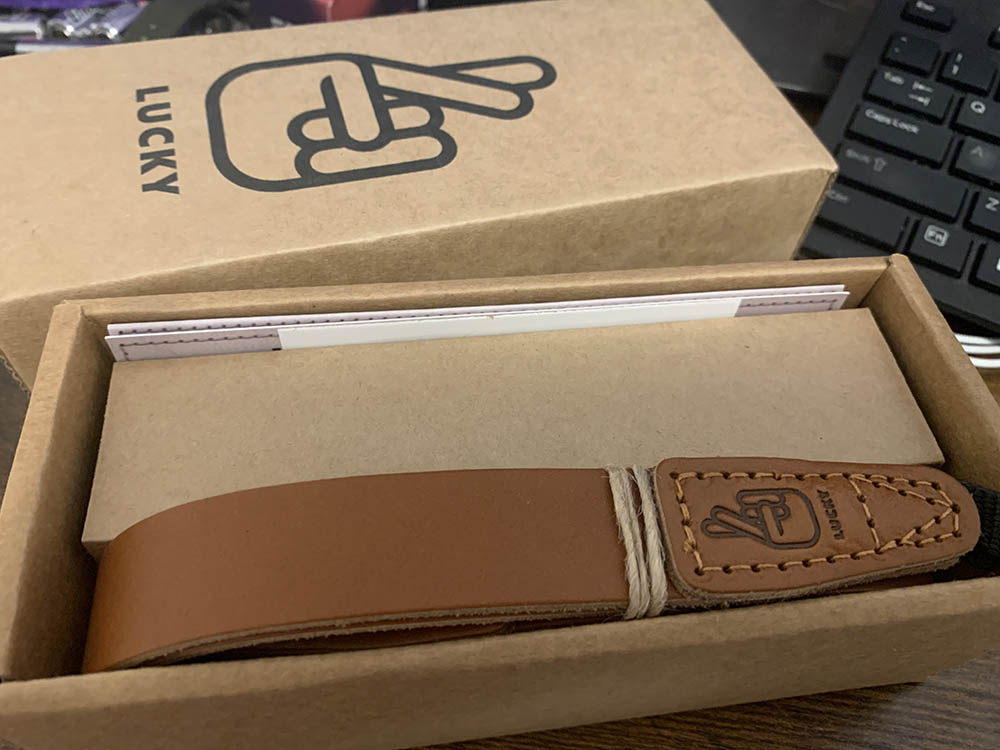
The packaging looks upscale but minimalistic, very elegant. However, I think that this is overkill as you can see from the photo – the strap only takes less than half of the box’s area! I’d rather have a smaller box and save that extra money, every dollar counts these days.
Help support this site by donating to richardHaw888@gmail.com over at Paypal! If you want to buy me a beer or a roll of film then that would be great,too!


 Richard Haw's Classic Nikon Repair and Review