Hello, everybody! Chinese food is very oily, that’s why I try to avoid it as much as possible. Hot pots, fried foods, stir-fry, and even some steamed foods require a lot of oil in the process somewhere. You will have to choose which ones to eat because there’s still some healthy options such as steamed dim-sum. Food in mainland communist China and in some cases India as well are of questionable sources. That is why spice, oils, and other additives are used to mask the quality of the food. This isn’t to say that everything there is going to give you cancer, I’m just pointing out that some bad people will do anything to fool people even if it means endangering the health of many innocent lives. Today, I will show you something disgusting. It is just as oily as a Chinese food that I talked about, and just like the practice of masking food safety, it also has a nefarious way to give an impression that this product is of higher quality. Read along with me.
Introduction:
The 7Artisans 35mm f/1.4 II was probably announced around 6 years ago during the pandemic that came from mainland China. I have no idea when it was sold but I have been seeing it for a long time. I do not know what are the exact differences between the first version and this one except that the older one has a different design with more glass and aperture blades. What I know is many APS-C shooters with Sony and Fujifilm got one of these because they’re cheap and decent. I’ve also heard of people complaining about poor quality control and other similar concerns that we’re all so familiar with when it comes to “Made in China” products. The support is poor overseas so it will all will depend on who you got it from if there are any warranties at all. These come in different mounts but we’re only talking about the Nikon version in this article.
The exterior is completely made of metal. It feels heavier than it should and in an excessive way, too. The impression it will give people who don’t understand things is that they’re getting a premium product. It’s quite nice when it comes to the fit and finish as the exterior is concerned, and that’s all there is to it. We’ll also learn why this thing is so heavy and why the aperture ring does it have any detent clicks.
Hello, everybody! Have you ever fancied making love to that hot girl you had a crush on when you were young? I’ve had several regrets in my life and one of them is not getting it on with that girl that the whole batch was swooning over at that time. It’s really sad, after a couple of years I’ve learned from her own lips that she had me in her heart all along ever since we were 14! She’s this amazing, beautiful, and intelligent woman, she deserves everything best in her life. You can say that she is a jewel amongst gravel, that’s how rare she is, and she has aged beautifully! It’s pointless grabbing on to your memories and so playing with your turtle won’t bring back time. With all that frustration, something good has to happen, right? Well, it’s fortunate that I’ve been able to finally purchase something that I have always wanted with my tax return. I felt so much relief that it has healed my decades long worth of regret even for a short time. Do you want to know what that is? Please read this article so you will know all about this magical lens that can heal the heart of an old man.
Introduction:
The Micro-Nikkor 5cm f/3.5 is a very special lens, with an equally special purpose and legacy. It is the first Micro-Nikkor ever made. It was sold in 1956 and only two special clients who requires high resolution for their lenses. The special cases are reproduction, microfiche, scientific use, the medical field, and so on. It’s the best in terms of resolving power of all the rangefinder era Nikkors, even when shot wide-open. There was a need back then to manufacture a photographic lens with enough resolution to capture the intricate characters used in the Japanese language so Nippon Kogaku took on the task to design a masterpiece. It’s development is partly documented in the amazing article by Sato sensei. You can also read my old article about the Micro-Nikkor 5cm f/3.5 in Leica mount.
Unlike the Micro-Nikkor 5cm f/3.5 in Leica mount, this one does not have a focusing unit and it uses the helicoid of the camera to focus. What’s similar is it shares the collapsible design that serves some purpose when you want to use this for shooting at higher magnification. The construction is the best I’ve ever seen amongst all small 5cm rangefinder Nikkors. There’s no slop and the finish is exceptional. This is a high end product in every way, even the tiny screws are exquisite.
Hello, everybody! Do you know the song “Torn Between Two Lovers” by Mary MacGregor? This is a song about a committed woman who is seeing another man. It’s not that she doesn’t love her partner but the other man has “better performance”. I’m not a woman, and I am a loyal husband but I understand what’s going on inside of her because this feeling isn’t always confined to relationships. You can be torn with a lot of things in life, in my case it’s the choice between the de facto zoom lens for my Nikon 1 cameras or a similar one that does much more but lacks something that I need. Have you been in such a situation and what did you do? Of course, we are living in a free world so we get to choose which one we need. You can also choose both if you are so willing. This is the gift of liberty!
Introduction:
The 1 Nikkor 10-30mm f/3.5-5.6 VR was sold from late 2011 to several years later when the whole Nikon 1 system was discontinued. They can even be found new when sold together with old stock camera bundles as late as just a few years ago as of writing. It is the kit lens for the new Nikon 1 system cameras and these were mostly sold together with the cameras as a kit. They have a mixed reputation, some hated it while a devoted group will swear by its optical performance. It’s truly inconsistent in that regard but everyone will agree that this “made in China” lens is flimsy. Things got so bad that Nikon had to offer free replacements of the worn or flimsy parts inside of it without any additional cost. I’m impressed by this because it shows that Nikon has accountability, unlike some other brands.
The whole barrel is made up of plastic to make it compact, cheap, and affordable. It has a minimalist and modern design for its time so you only have a zoom ring with a lock to interact with. You need to turn the zoom ring to the 10mm position in order to use it.
Hello, everybody! Do you know about the story of “Long Long Man“? It is a love story about a woman who is torn between his lover and a third-wheel in their relationship, a love triangle like no other with a twist at the end. It is an amazing story that can be considered a modern classic, it’s something that we should all watch at least once in our lifetimes. Watching that very short movie will help you appreciate what you are about to read in this article today. It’s also about something long, but unlike “Long Long Man“, it does not end in tragedy but there’s a little bit of a plot twist with this lens’ barrel construction.
Introduction:
The Nikkor 400mm f/5.6 ED-IF Ai-S is a masterpiece. It was made from 1982 up until 2002, a long 20-year run which is kind of unusual for a lens of this kind in my opinion. On the other hand, it’s understandable because it’s considered to be an exemplary performer. The Nikkor 400mm f/5.6 ED-IF Ai that came before is optically similar to this one except that the tripod collar is narrower. At least that’s the most obvious of all external distinction between both lenses. There may be some differences internally but I can’t confirm. This lens has a huge following amongst bird shooters and train spotters because of its weight and stellar optical performance. Very few lenses of this type could match it in terms of popularity, these are always in demand. For that very reason, it’s not easy to find a cheap one but I got really lucky and I’ll tell you why.
It is long, huge and black. The build quality is exceptional, fit for professional use. It is also very heavy so a tripod collar is supplied with the lens. Unfortunately, mind did not come with it so I was able to buy it for a very cheap price. There are three rings that you manipulate with – the aperture ring, a focusing ring and another ring that allows you to sort of constraint the range of the focusing ring, we’ll talk about it later. Its barrel never extends nor retracts as you focus because it’s an IF (internal focusing) design, this is helpful if you mount it on a tripod and doing precision work since the balance of the lens doesn’t change.
Hello, everybody! This city cannot compare to Tokyo when it comes to shopping for cameras. It does not have the specialty boutiques that Tokyo has such as Kitamura Camera nor the used and junk paradise that is Fujiya Camera. However, it does have its own specialty places that cater to a certain type of market. You can say that it’s the equivalent of Mapcamera’s Leica Boutique in Shinjuku, but not quite there. Whatever it lacks in scale it makes up for the personal service that I’m used to in Japan, where the staff knows me by name and preference. This is the place to be in this side of the city.
Introduction:
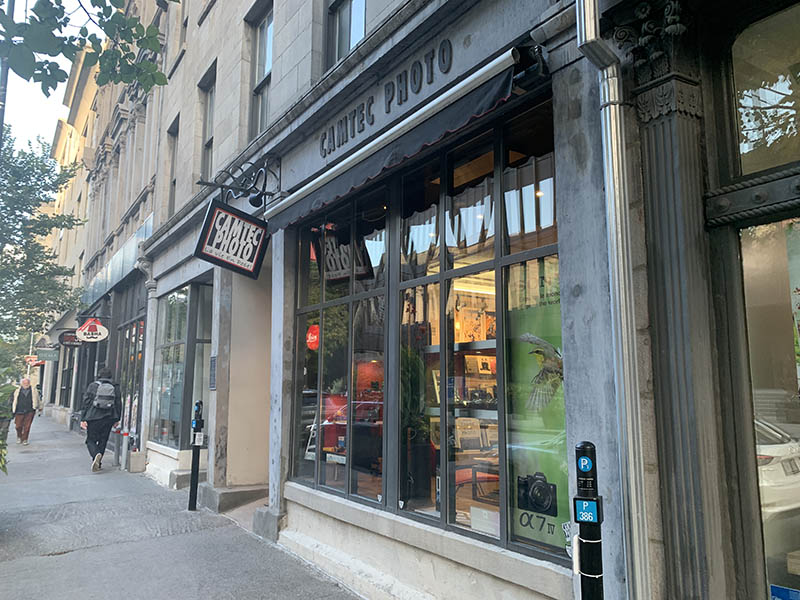
Camtec Photo has been in operation for some time now and it is considered to be one of the best places to buy cameras in Montreal. They have two shops that are about a kilometer apart, we will talk about the one that’s more interesting because the smaller (original) one doesn’t have the same character compared to this shop.
This is the storefront which you can’t miss because of the sign and large windows. It looks small from the outside but it’s actually much bigger inside. I mostly use this shop for my processing and digitizing needs because they are fast and they won’t throw away your film if you have forgotten to pick it up. Other shops will throw them out if it didn’t pick it up after a few weeks.
Bonjour, tout le monde! Es-tu un “poseur“? A poseur (poser) is someone who fakes his credentials to gain respect. He will try to wear expensive clothes to impress people or claim to be someone that he isn’t. I do not think it’s always a bad thing because we all have fantasies of our own, whatever they are. I sometimes imagine myself as a buff plumber giving assistance to a helpless housewife. We are all free to live up our own fantasies. There’s always a child inside of us, and this goes with photography as well. You can live an illusion all you want and it can sometimes be temporary so you can get back to your normal life when it’s convenient. We should never do anything permanent until we are in the right mindset. Today, I will show you how to live your wildest dreams, that is if you want to fantasize about being a press photographer.
Introduction:
Many people purchase cameras based on how they look and feel in their hands, these are accessories as much as they are tools. A lot of people buy black Leicas (or other black classic cameras) because of how they look when they are worn and weathered. Unfortunately, that worn look takes plenty of time and lots of handling just to get the brass parts underneath peeking out, and even more time and handling just so the patina will look just right. Some people don’t have the time and patience for that, so they cheat it by using sandpaper or denim to permanently wear the paint down. The result looks fake as fuck, but so are they. I will show you in this article an alternative way so you won’t fall into this foolishness, what’s better is it’s all temporary and you can clean it off anytime. It will also work on plastic parts, too!
This is the result that I got after spending not more than 10 minutes of faking the look of a worn camera. Do you think it looks convincing? I don’t think so but it can fool somebody looking from a meter or more.
Hello, everybody! Do you know about the song “Somewhere Over the Rainbow“? I’m pretty sure you have heard of it in one form or another. The original song came from the “Wizard of Oz” movie in 1939 which has Judy Garland in it. It has since been covered in different languages and by different singers, some are famous while some are unknowns. However, the best known version today is the version sang by the late Israel Kamakawiwoʻole, a huge mountain of a man with a sweet voice and a ukulele. I personally prefer his version over the rest because I felt it has more depth in it despite being simpler. A recent cover is at times better since the original song, it has happened several times. The topic of this article is something similar in the sense that it’s the last known version of a popular line of lenses. It’s also the best in terms of looks and ergonomics as it has benefited from several years of previous refinements. Read this article to know about this beautiful lens.
Introduction:
The W-Nikkor 3.5cm f/2.5 has gone through several iterations, what I’ll showcase today is the last one to come out of the factory. Nobody knew exactly when its production started or ended but this came out in the final years of the Nikon rangefinder era around 1959–1960. The optical formula remained the same, it is the barrel that’s new this time. The design of the barrel looks similar to the W-Nikkor 3.5cm f/1.8 so the aperture values are much easier to see and the barrel is much lighter compared to the older ones since it is now made from aluminum alloy instead of brass. In my opinion, this is the best version of this lens. The ergonomics alone is worth the extra price and rarity of this little gem.
The barrel looks very beautiful and modern compared to the older versions of this lens. It is easier to see the numbers now that the barrel is colored black and the letters are in white. The knurling also helps a lot so your hands will not slip and it also makes it easier to recognize which barrel you’re operating.
Hello, everybody! Do you know about the Uyghurs? They are a Turkic people living in East Turkistan which is called Xinjiang by the CCP Chinese. They are a proud people with a long and profound history. They are culturally different from the rest of communist China, because they are not part of the Han majority. They are closer to the Uzbeks, Turks and other Central Asians. Their way of life is threatened and many of them have fled to other countries as they are being persecuted, much like the Tibetans. This is to say that not all people who live in communist China are all “Chinese“, some are cultural minorities who have their distinct way of life that’s in danger of being wiped out. Today, we’ll talk of something along those lines. It’s a lens that looks similar the rest of the family, but it’s certainly different in small ways. It is important to make a distinction so we will know exactly what’s in front of us.
Introduction:
The Nikkor-S•C 5cm f/1.4 is one of the lenses that I have covered many times in this site. Many of you got familiar with it through my articles. I did not think that I would ever write another article about it, but here I am presenting you with another one. This time it’s an early version from the first part of 1950. This is the coveted “5005” series, the earliest production of the Nikkor-S•C 5cm f/1.4. This particular lens is from the 2nd batch which has less digits in the serial number, but still valuable compared to common later versions that everybody has. These are valuable because some people consider them as “Made in Occupied Japan“. While it’s technically not an “MIOJ” lens due to the lack of the engraved country of origin, the date it was manufactured should put this together with the other genuine “MIOJ” Nikkors. This is only important for a certain group of collectors, whatever its true nature should be.
The barrel is similar to the more common later version except for a few minor differences such as the different typeface used, along with being somewhat heavier. The last version (in black) is the lightest, it has many parts that are made of a lighter alloy.
Hello, everybody! Do you love blue cheese? I love it a lot and I eat it almost everyday. My favorite is made by the Danes, le Danablu or Bleu Danois. It’s not as stinky as Roquefort and it’s a bit dryer so it crumbles. It stinks just as well so the general taste and texture is slightly similar despite not being moist. There’s a lot of different varieties of blue cheeses, I hope to taste them all one day. How about you, do you like eating blue cheese? How do you like it with? Speaking of the differences between French and Danish cheeses, I’ll showcase something that came in different versions. You can think of it as Danablu and Roquefort in some ways because it’s essentially the same thing but they come in different flavors.
Introduction:
The Nikkor S•C 8.5cm f/1.5 is a legendary portrait lens for many Nikon shooters. Many people dreamed of owning one of these back in the day as it is today. It’s the Nikkor available for the Nikon rangefinder, and also for the whole company as well up until the introduction of the Nikkor 85mm f/1.4 Ai-S which is some 28 years after this one came out. I have written another article about this lens in Leica mount, so please go and see that article to find out more about its history and some other tests that I have done. We will only talk about what’s different in this article.
The all-metal barrel is robust, and feels substantial when held. You will never get anything like this today, especially from the CCP (Cheap Chinese Products). Everything feels precise and it’s nothing short of total luxury.
Hello, everybody! The recent Olympics has been controversial, we are even discussing some of the topics to this day and for many days to come. Some find it amusing well some people were offended. Some say it was done in poor taste, while some people claim that it points to the next step in human psychology. I do not dare to make such bold claims because I am merely a camera repair enthusiast. But this is what I can say, we can all agree that some parts of the event left us scratching our heads. To me, it was the huge disrespect by the Australian “dancer” to her sport. In this website, we do not disrespect anything related to Nikon. In order to wash away the trauma, I will present to you another “Olympic“, one that is hailed by many as a masterpiece and the best there is, even to this day. Let’s all celebrate and enjoy the “Olympic“.
Introduction:
The Nikkor-S 50mm f/1.4 (Olympic) was made in 1964 under a limited batch of less than 1700 units. It’s even rarer than Nikkor-S 50mm f/1.4 (Millennium) that is a reproduction of this lens. That year is special because of the Summer Olympics hosted by Japan. Many companies saw that as a chance to showcase their prowess by manufacturing exceptional products to be used for covering the games. Nikon made a couple of such projects, the lens you see here is one of them. It’s also the last lens ever mean by Nikon for the Nikon S rangefinder system that isn’t a reproduction. Many people consider this to be the best 50mmNikkor of its kind because of how well it performs technically, it’s surprisingly good even at f/1.4. That’s a big departure from what many people were used to with the older Nikkor-S•C 5cm f/1.4, which renders a lot differently because it’s considered to be “soft” when shot at larger apertures; that’s just the case when shooting with Sonnar-type lenses. Speaking of which, this is the only 50/1.4 rangefinder Nikkor that isn’t a copy or derivative of the famed Sonnar design.
This is by far the largest rangefinder 50/1.4 Nikkor ever made. It is longer and considerably wider than the older Nikkor-S.C 5cm f/1.4, and it’s heavier, too. The barrel is all-metal so it feels great when you hold it. A lighter type of alloy is used on some parts in order to make it weigh less so it feels a bit different when it’s held. This is in contrast to the older lenses which uses brass.
Help support this site by donating to richardHaw888@gmail.com over at Paypal! If you want to buy me a beer or a roll of film then that would be great,too!




 Richard Haw's Classic Nikon Repair and Review