Hello, everybody! I went to the Nikon Museum yesterday afternoon and went to the small conference room under it to listen to a talk about the prototypes found at the Nikon’s Ohi Plant before it began being demolished due to the building’s age. The talk was by Nikon’s head of professional camera development from the Nikon F3 to the Nikon Df, a great guy by the name of Mr. Goto Tetsuro. There were around 60 people in the cramped room and we sat there for around 2 hours of Nikon geekery. There were lots of information, trivia and insights that were shared yesterday afternoon that would have been inaccessible to people who are not working at Nikon or the Nikon employees who don’t have anything to do with camera development. It was a good afternoon despite the heat and hunger.
The talk was light-hearted and can be compared to a journal recollection of some sort so there were many small things that were inserted into the program that weren’t originally planned. There were many important information shared about the development of the F-mount, the Nikon F and the Nikon F2 and I will share them one of these days in my blog so come back here everyday to add to my click counts! Do click the ads when I have them here in the future to help me pay for the overhead and server stuff!
Look at all these beauties! If only I can take them home! What you see here is definitely worth hundreds of thousands of dollars! This is the closest thing we can get to traveling back in time to Nikon’s early years in consumer camera production. It is as if I can see, smell and even contact the very people who were involved in these prototype cameras.
Hello, everybody! This is a follow-up post of my Fujifilm Natura 1600review from a few weeks back. I believe that I have generated some interest in this film just by looking at my blog’s stats so I decide to write this.
The previous part showed how this film looks like in a crowded Tokyo alley lined with all the vivid colours and shades that you will find in a techno-punk scene and in this article I will show you more low-light scenarios where this film will be handy.
Before anything else, I would like you to know that I process my film after I digitize them and part of the process is to colour-correct my pictures. I do not add any contrast to it but the colours aren’t as faithful as the original. Other than that, everything is pretty straight. I do not even add or remove sharpness or meddle with the noise reduction for all of my digitized film. Having mentioned that, please enjoy some more pictures from Fujifilm’sNatura 1600 shot my me here in Tokyo!
Hello, everybody! I was looking at some watches a while back. They’re the fancy ones that could rival what a smart-watch could do. It’s amazing how far technology has brought us. What we saw as kids in the movies or television is now a reality. It’s unthinkable back then how much technology you could pack in small things. It makes science fiction authors a few decades back feel like they’re uninspired. Today, I’ll show you something that’s small but it’s also a wonderful tool. Unlike the super-watches that I mentioned, this one was made at a time when people still made things the old way.
Introduction:
The Nikkor-H•C 5cm f/2 was conceived during the war but it was only sold from 1946 until 1962. It was made in several minor versions and a few different mounts throughout its production. It was Nikon’s standard lens for its rangefinder-coupled cameras and it was sold along with cameras as a kit.
It’s usually sold with Nikon-brand cameras such as this Nikon S2. It’s a great walkaround lens, you’re neck will not hurt after a whole day shooting with it. It’s heavy despite its tiny size since the barrel is made from brass. I love how “luxurious” it feels when held. It’s a very well-made Japanese lens for its time. The later models have black barrels and the internals were made from aluminum, making them a bit lighter.
Hello, everybody! How are you tonight? I am going to write something about a film stock I use occasionally here in Japan. This is my first film review here on my blog. I am not an expert in the field but I believe that I know enough about film to give you guys a general idea on how a film looks and behaves. Read along and enjoy!
Introduction:
Tonight, we are going to talk about that elusive film outside of Japan from Fujifilm and it goes by the name Natura 1600! It is a wonderful film for lowlight photography and is the only one I am aware of that isn’t exotic as far as C41 colour films are concerned. It does have it’s quirks and I will tell you what I have experienced with this film so far and after shooting a handful of rolls of this film, I think I now know how this film behaves under the conditions that it was meant to be shot. Again, take my words with a grain of salt!
Fujifilm Natura 1600 is unique and it occupies a niché market where it does not have any real competition. It’s a very good film for it’s price (at least here in Japan). Try it yourself!
Today, we are going to do an unboxing video of the B+W UV-Pro Premium fungal spore and bacteria killer. This will supposedly sterilize your lens by using UV light pulses to kill any germs on the surface of your camera’s sensor or lens. Watch the video and see what’s included in the package! Enjoy!
Hello, everybody! How are you this weekend? I’m currently happy playing with my Nikon rangefinder cameras. They’re very fun to use and while they are not as accurate and as precise as the F-mount SLR cameras, they win in the fun department with many intangible qualities that make them worth using despite all the hassle and quirks of the NikonS-mount camera system. Like what I told my friend yesterday, you must follow your heart because it can detect the intangibles of life. Today, we’ll talk about a lens that adds an intangible quality to its pictures, making them look exquisite.
Introduction:
Today, I will introduce to you the venerable Nikkor-P 180mm f/2.8 Auto! This lens is really good that many people still shoot with it. It’s considered to be a hidden gem of some sort these days because many tend to ignore its modest specs and the f/2.8 maximum aperture doesn’t appeal much to many people these days but I will show you in this blog post why this lens is still relevant today as a professional lens for portraiture and fashion if focus speed is not much of a concern (you focus it manually).
The lens is so dense that it feels like holding something from the gym. Let us see if the flimsy new electronic lenses for mirrorless cameras can survive a direct collision with this. It feels like it was built to survive a nuclear war in the Cold War. Everything about its build is professional and there’s nothing I can think of that can easily break in this lens.
Hello, Everybody! How are you guys today? I’m stuck at home today to take care of baby. It was a very tiring day because my toddler is full of energy! Cameras are like humans in a way in that they come out of the factory working fine but as they age and wear it will begin to show and the performance will deteriorate. I am in my mid-life and I feel like an old man now as the years of abuse is finally taking it’s toll on my health. The good thing with cameras is that you can fix them to a certain extent or change the parts to make it work closer to factory specifications and today, I am going to show you how to perform a simple maintenance routine for your 60 year-old Nikon SP/S3/F/ and even the Nikon F2!
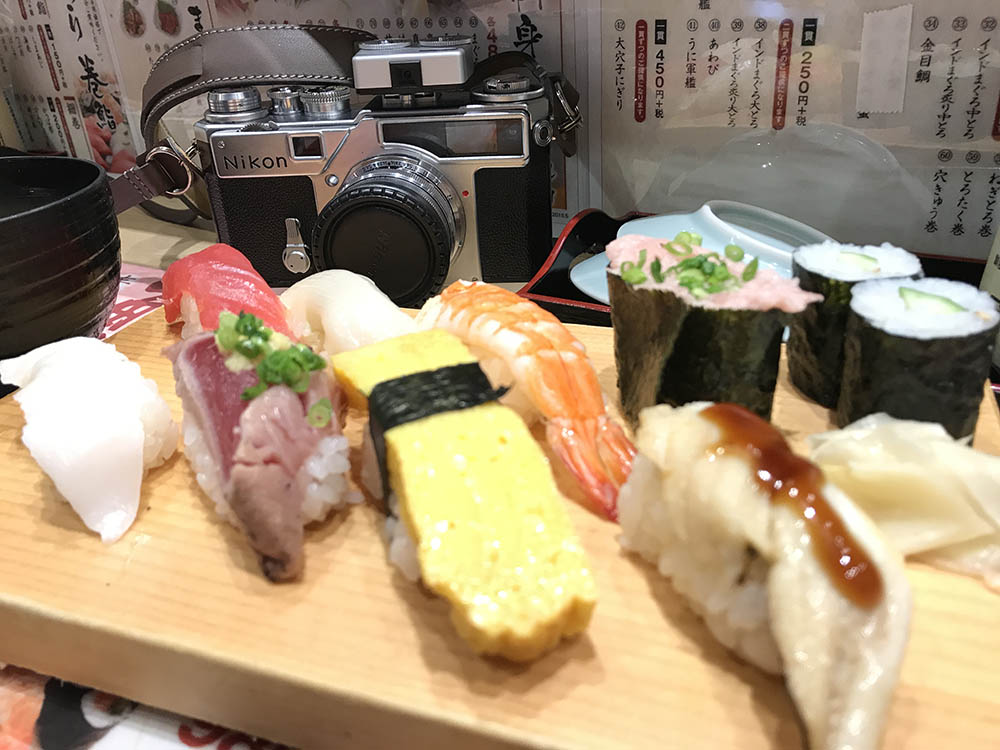
Look at all the yummy food! This sushi place has an all-girl staff. I would rather prefer to eat one prepared by a pretty young woman than a middle-aged Japanese chef obviously.
Hello, everybody. This video is kind of late and I should have made this years ago. I was a bit busy but I finally found some time to make a video about this topic. Beginners usually face this problem and quit It so I hope that this video will reach somebody in trouble and I hope that I can help him before it is too late.
Oh, the seasons are changing. We are now entering mid-Spring and the weather here in Tokyo is beginning to get warmer and more humid but it is still relatively cool specially if you compare it to the punishingly hot summers here in Tokyo. This transitional weather is making me sick and I have another gout attack again so quality of life has gone down a bit. Speaking of transitional, I am going to show you a very important transitional lens in this week’s article so please stay and read along.
Introduction:
We’re going to continue with our series on the 105/2.5 family of lenses and the next one’s the successor to the previous one that we discussed last month. This one came with better coatings and hence it’s called Auto-Nikkor-P.C. 105mm f/2.5! The “C” stands for “coated” so Nikon’s marketing is simply reminding you that this lens is different and that you should buy it in case your lens is not coated. Sarcasm aside, this is an awesome lens and I shoot with this lens quite often because of the unique look that it gives to my pictures.
This lens came to me in a rough state but the glass was clean so I did not bother to open the objective up to clean it as it would be pointless. Looks like a pro used this lens as you can see from the wear but that is no problem at all, in fact the wear made it unique.
Hello, everybody! I just had a quick look at Nikon’s D7500, their latest camera replacing the the D7200. Please check out my video below and see what you think.
I decide to make a video this time since it is better to present this in that format. Reading commentaries won’t be as good as watching a video for something like this.
By the way, I mistook Qc mode for Ch mode! That was very stupid of me, this is what is going to happen when you shot with film cameras for too long! I’m not going to bore you further more. See you next time, Ric.
Help support this site by donating to richardHaw888@gmail.com over at Paypal! If you want to buy me a beer or a roll of film then that would be great,too!

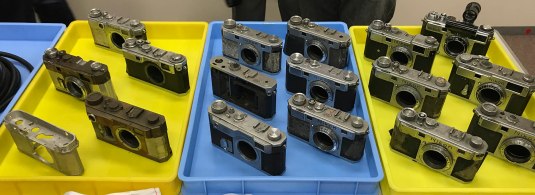 Look at all these beauties! If only I can take them home! What you see here is definitely worth hundreds of thousands of dollars! This is the closest thing we can get to traveling back in time to Nikon’s early years in consumer camera production. It is as if I can see, smell and even contact the very people who were involved in these prototype cameras.


 This lens came to me in a rough state but the glass was clean so I did not bother to open the objective up to clean it as it would be pointless. Looks like a pro used this lens as you can see from the wear but that is no problem at all, in fact the wear made it unique.
 Richard Haw's Classic Nikon Repair and Review