Hello, everybody! I am going to show you one of my favorite films today. It’s popular these days and many people use it to get unique-looking pictures. I love it a lot because I like taking night-time photos and this works great for my style. If you’ve been following me you already know what I am talking about. Enjoy this review.
Introduction:
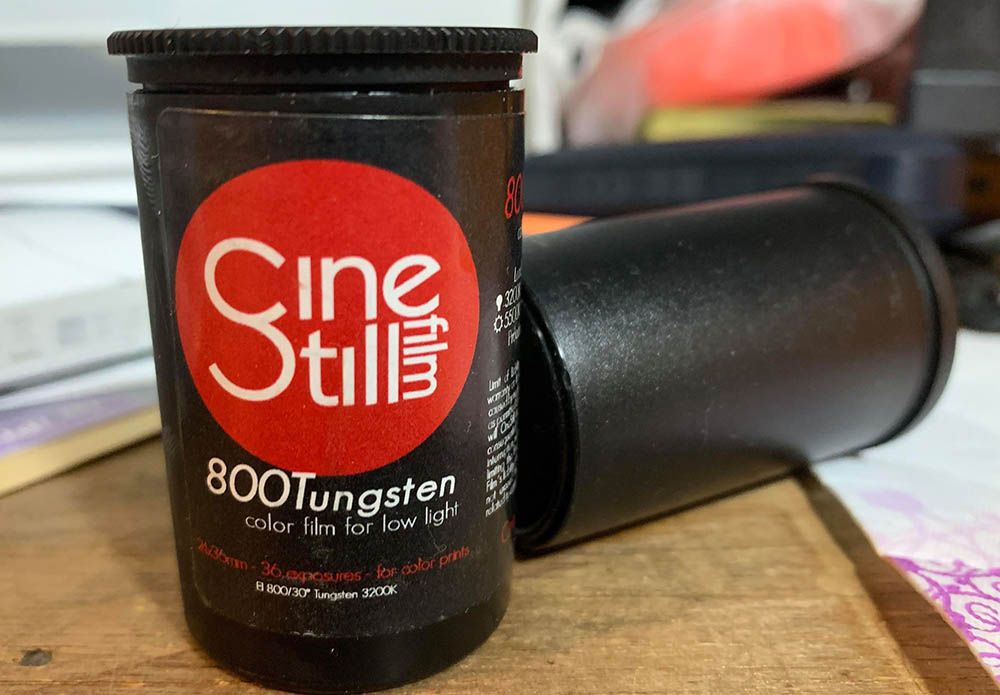
Cinestill 800T is one of my most-used stocks. I was looking for an alternative to Fujifilm Natura 1600 so I tried my luck with this film which turned out to be a good find. It’s originally a motion picture stock that was re-spooled for normal use and development by hobbyists, I will get into the details later in this article so be sure to read everything.
It comes in its familiar black container because it’s very sensitive to light. It is sold in both 35mm and 120mm formats which is nice. I have seen how it performs with medium format and the results blew me away. They’re a bit pricey depending on where or how you buy them but not unreasonable.
Hello, everybody! Do you remember “Somewhere in Time” with Christopher Reeve? I love that movie a lot despite it being corny. I think its soundtrack is also one of the best scores ever written for a movie, I can still remember the first time I heard it and I can never forget it when I hear it. Movies like this are timeless and you can still enjoy them to this day. It’s difficult to think of a movie made today that has the same impact, it is easy to forget a movie as soon as you walked out of the theater. Today, I will show you a lens that will bring you back to the olden days, very much like the plot in “Somewhere in Time”. It’s also a classic that only people who have a deep appreciation for the past will revere.
Introduction:
The Nikkor-Q•C 5cm f/3.5 is one of Nikon’s oldest lens designs for the 35mm format. Its history dates back before the war and it was also supplied to the first Japanese 35mm cameras made by Canon called the Kwanon. The design is very simple and it’s simply a clone of what the Germans had. Nikon didn’t know how to make or design lenses for 35mm cameras so they had to start somewhere and the best lens manufacturers at that time were German. The lens has undergone many changes through-out its life from 1935 to 1956. It has seen several barrel updates and they were sold in different mounts. It’s what gave Nikon the required know-how so they can start making original designs after the war and that makes this lens special. Many people are not even aware of these and you certainly won’t find a lot of information about this lens online and photos that were taken with this lens can be difficult to find. Most people who own these are collectors and they usually do not use their gear to take pictures, which is a shame.
I got this lens for a small price but these usually go for around $500 and up. I was lucky and it was fated that this lens ended up with me. The barrel is a clone of the Leica Elmar 50mm f/3.5 but you adjust the iris via a ring behind the front ring which makes it more convenient since you can see the values without having to look at the front of the lens. The optical formula is also a clone of the Leica Elmar 50mm f/3.5’s which is a clone of the Zeiss Tessar. It’s a clone of a clone!
Hello, everybody! Do you remember Quiet Riot? They’re best known for the cover of Cum on Feel the Noise by Slade and Metal Health. The Slade song is one of my favorites but Quiet Riot’s version is better in my opinion because it gave the music a more modern, grittier sound. I don’t know if the younger head-bangers know what I am talking about so just check them out if you’re not familiar with them. Speaking of revisions, I will talk about an important camera today that turned Nikon’s first camera into a world-class product by implementing many clever changes.
Introduction:
The Nikon S2 replaced the Nikon I/M/S line of cameras. It’s an important one because it laid the foundation for their next camera, the Nikon SP. It’s still a simple camera when it came out but it was a huge leap from the Nikon S. It now sports a much bigger finder, an advance lever, 1/1000s speed, a rewind crank, a proper A/R ring and much better build. This camera made Nikon an important name in cameras because Japan now has something serious and respectable to rival the German cameras to a certain extent. It sold well, it’s Nikon’s most numerous rangefinder camera and the most common one you will see in the used market. Despite the numbers, the prices for these aren’t going down but they’re getting more expensive as people get to know them and how comfortable they are for regular use.
The Nikon S2 is a beautiful machine because of all the big dials and the nice silhouette. It’s probably the sexiest Nikon rangefinder camera in my opinion specially if you mate it with a good-looking compact lens. It only comes with a 50mm viewfinder, a standard for its day but it’s life-size and very bright. I love how you don’t have to squint because of it since what you see on both of your eyes is the same magnification. It’s not parallax-corrected, which is a missed-opportunity. If you need to shoot with a different focal length you will need one of Nikon’s many external finders such as the one you see here.
Hello, everybody! Do you remember the original Fiat Multipla? It’s an ugly car that has quite a following. It’s unusual in terms of design but all of the design decisions made a lot of sense at the cost of its looks. It was ahead of its time in some sense yet it sends you back to a time when cars look more cartoonish and real charicature of what they’re supposed to be. Despite its looks, many people loved it and I imagine that taxi drivers and couriers all love it for its utility and comfort. I never owned one but that car fascinates me to this day. I am one who doesn’t care much about how people judge me and my fashion sense so long as I am comfortable with my choices. I would like to introduce to you a lens today that is a bit quirky and it went against what the market wanted back then but it won the hearts of those few who know what they really wanted in a lens.
Introduction:
The Voigtländer Color-Skopar 50mm f/2.5 is an odd lens when it came out in 2002 to compliment the Voigtländer Bessa R2. Both were made by Cosina, it sounds weird but Cosina now owns the Voigtländer tradename. Going back to the odd part, this lens was made with specs that fit a 1950s lens, with the slow maximum aperture to match it. It was made for the M-mount, S-mount, the original Zeiss Contax rangefinder mount and the Leica screw mount. Its specs may not be impressive in 2002 but it struck a nice niché market along with the other lenses that Cosina made under the Voigtländer name. People were still shooting with these mounts to this day and we sometimes wanted something “modern” without having to pay a ridiculous amount for a Leica (at least for the M-mount) and the cheap communist Chinese lenses weren’t even available then. Even if they were, I would happily pay a little premium just to get reliable Japanese quality instead of those ghastly Chinese lenses.
I got the Voigtländer Color-Skopar 50mm f/2.5 in S-mount and it’s feels great to hold and use. It’s not as heavy as the old classics that were made with all-brass parts but you can certainly feel that it’s not flimsy. Its finishing is nice and is certainly much better compared to the Chinese cheapies. You can feel that Cosina has put-in a lot of effort to make this rival the German lenses in terms of build. The tolerances are tight and there are no sloppy paint jobs in the barrel. Everything feels premium despite having a modest price. I think these were sold for as little as $500 then and you can still buy them new for just a little over that these days. The S-mount and Contax RF mount versions are the cheapest at $400 each. I got mine in mint condition complete with its box, hood and everything for just $170 used. How can I resist it? This makes for a good general-purpose lens and it’s compact so it’s not a hassle to carry. I don’t know why Cosina did not make it as an internal-mount lens because that will make it even more compact and light.
Hello, everybody! I went to Tim Ho Wan to have the cheapest Michelin Star dinner I can give to my family. I liked how the dim-sum tasted, it reminded me of the food that I’m used to back home. It’s great how high-end dim-sum can be made affordable and accessible to the masses. Tasting food this nice used to cost a lot of money but you get value with with Tim Ho Wan. I’m not sponsored by them in case you are wondering, but they can contact me and I’ll happily accept their offer to eat their food. Today, we’re going to look at a lens that used to be expensive but you can get them now for cheap. They’re the best that you can buy back then as far as wide Nikkors go but they were soon replaced by better options so their price has gone down. Please stay so you can read more about this wonderful lens.
Introduction:
Its size is perfect for all of Nikon’s cameras as it’s not too small or too big. It’s great as a walk-around lens on a bright day. Pair it with a longer lens which will give you a little bit more reach and you have a complete setup. The lens looks great when paired with a camera of similar vintage and you’ll attract a lot of attention. They’re not that expensive either so people who want the cheaper option will be happy to own this lens. There’s nothing cheap about its performance as you will see later in this article. It’s not the best lens out there for the price but it sure does its job in style. It is like wearing a pair of nice British bespoke shoes with a nice suit. More
Hello, everybody! I was hungry for some Taiwanese food so I went looking but I found that most of them were ran by the mainland Chinese people and there was nothing Taiwanese about them apart from what’s written in the sign. This is unacceptable, I hope that this practice ends because it’s unfair to the peaceful Taiwanese people. If you do not know any better then you’ll get the wrong impression about the Taiwanese because the people running these shops are mainland Chinese. Speaking of being confused, we will talk about a confusing subject today in Nikkor land but this time, you will get an excellent lens whichever one you end up and unlike the example that I just gave, it is not some shoddy knock-off trying to deceive people but it is just Nikon being lazy and will show you why I said that and how you will know which version you’re looking at.
Introduction:
We are going to showcase the New-Nikkor 35mm f/2.8 lens today, a lens that is usually mistaken for its successor, the Nikkor 35mm f/2.8 Ai since they’re almost identical apart from some insignificant details. This lens replaced the beloved Nikkor-S 35mm f/2.8 Auto in 1974 and it’s a total re-design from the optics to the barrel. From the old 7-element design it now sports a new 6-elements-in-6-groups design and a new barrel that’s more in-line with the New-Nikkor line of lenses. The successor to this lens (Nikkor 35mm f/2.8 Ai) is essentially the same lens with an Ai-ring and a slightly-different rubber grip pattern. To the untrained eye, they look identical specially if the New-Nikkor 35mm f/2.8 sports a factory Ai-ring upgrade. The parts can mostly be interchangeable as far as I remember so I lumped the two lenses into one. Why did Nikon do this? To save money, because in just a few more years the later Nikkor 35mm f/2.8 Aiwas sold and that’s what I believe is what Nikon really wanted to sell as the Ai version but it probably didn’t make it in time, that’s just my theory but it’s very likely to be the case.
It’s a wonderful little lens that not a lot of people know about but the few who do know it for a special reason which I’ll mention several times in this article so pay attention. Some people poo-poo this lens but it’s a great little lens if you know how to use it. More
Hello, everybody! We are going to continue with our Nikon Museum Special Collection series and we’re going to see some special Nikon cameras here in this report. Nikon has made many special-purpose cameras and this is just a small portion of what’s been made. I spent the most time in this portion and I really enjoyed observing the special cameras and I hope that you share my enthusiasm.
This is the Nikon F2MD, it’s rare and some people don’t even know about it. It has the special Electornic Eye (Nikon EE) attachment that controls the size of the mounted lens’ aperture automatically based on the reading from the mounted metered prism that supports it. The big drum magazines can hold about 750 frames of film. Mounted on it is the special Nikkor 200mm f/2 AI, I want to own one of these but I don’t have the space to store it. More
Hello, everybody! I am going to walk you through this part of the exhibit where we find some surviving equipment from WW2 that was made by Nippon Kogaku that are special or interesting. Periscopes, gun sights and other “normal” things won’t excite some people so here are the more exotic ones. Nikon was called Nippon Kogaku until recently and just like Carl Zeiss they were pushed-into the war effort by their respective countries by their own will or not. There’s nothing much you can do when the state demands so much from you. It can mean the end for you if you said no so there isn’t much you can do I suppose. I find this part of the exhibit fascinating because I was a scale modeler and I admire WW2 weapons and machines because they’re obviously archaic but still modern-enough to be relatable. Whatever these are, these are just objects used during the war and should only be seen as such. I was in a photography facebook group once and somebody showed an old WW2 Leica and some people just went crazy over it. Discussing engineering shouldn’t be tainted with politics. With that said, I hope that you share my enthusiasm in this post.
This part of the exhibit has some of the biggest items in the whole floor. They’re heavy so I was really careful so I won’t knock one of them over and make me the Mr. Bean of the Nikon world. More
Hello, everybody! I am going to begin a new series in this article and I am going to report on the current exhibit at the Nikon Museum which they call the “Special Collection“. It’s a very interesting exhibit showcasing some of Nikon’s more unusual creations that’s made for scientific, military, medical and other fields where specialized optics are needed. This is something that every serious Nikon fan should take part in and I will cover it for you if you cannot make it to the museum. If you can travel to Tokyo then please do so while this is still up and I am sure that it’s going to be worth your time. Please enjoy this report.
Nikon has a long history of making special optics such as this big thing, a telescope used for observing the night sky. This is one of the smaller ones and the ones at the picture at the back are its bigger siblings that are too big to fit the museum. This one is not part of the exhibit, it’s been in this spot for as long as I can remember but it fits the theme. More
Hello, everybody! I had SPAM for lunch today. SPAM is delicious, I love it so I consider it my comfort food. Many people don’t like it for personal reasons but it’s one of those things that just won’t go-away as portrayed in a famous comedy show from a long time ago. It’s a classic and its taste hasn’t changed for a long time despite some tweaks to the recipe. SPAM is SPAM and it will be with us for a very long time. While we’re on the topic of classics, I’ll show you a lens today that’s been here for some time and is still being made new to this day by Nikon. Like SPAM, some people don’t like it and some love it a lot for certain reasons which I will explain soon. Enjoy your SPAM!
Introduction:
The Nikkor 50mm f/1.4 Ai-S is the SPAM of Nikkors. It’s production started in 1981 and is still being produced and sold today. It was based on the popular Nikkor 50mm f/1.4 Ai which was based on the New-Nikkor 50mmf/1.4 before it. The optical formula hasn’t changed since the mid-70s and it’s still used on the Ai AF-Nikkor 50mm F1.4D that replaced it, which is also being produced and sold today by Nikon. It would have been retired long-ago if this lens is a failure but I consider it a “secret masterpiece” despite having burned by the performance of a bad sample of the Ai AF-Nikkor 50mm F1.4D. Some people will argue that this lens sucks and they’re correct to a certain extent. This is one of those lenses that has lots of sphero-chromatic aberration and coma if shot wide-open but it’s a feature of this lens because it renders beautifully. I love how the designers balanced and used these “flaws” to make this lens do what it does with its rendering and I’ll show you how to use this effectively in this article.
The Nikkor 50mm f/1.4 Ai-S handles better than the Nikkor 50mm f/1.4 Ai. Its focus throw is shorter which allows you to focus faster with this lens. It was launched in 1981 to complement the Nikon F3 and it has sold close to about 800,000 copies (as of writing) according to Roland’s amazing site. The update allows it to meter in all automatic modes with cameras that will allow it like the Nikon FA. It’s feels great holding one as expected from a classic Nikkor. More
Help support this site by donating to richardHaw888@gmail.com over at Paypal! If you want to buy me a beer or a roll of film then that would be great,too!


 The Nikon S2 is a beautiful machine because of all the big dials and the nice silhouette. It’s probably the sexiest Nikon rangefinder camera in my opinion specially if you mate it with a good-looking compact lens. It only comes with a 50mm viewfinder, a standard for its day but it’s life-size and very bright. I love how you don’t have to squint because of it since what you see on both of your eyes is the same magnification. It’s not parallax-corrected, which is a missed-opportunity. If you need to shoot with a different focal length you will need one of Nikon’s many external finders such as the one you see here.
 Its size is perfect for all of Nikon’s cameras as it’s not too small or too big. It’s great as a walk-around lens on a bright day. Pair it with a longer lens which will give you a little bit more reach and you have a complete setup. The lens looks great when paired with a camera of similar vintage and you’ll attract a lot of attention. They’re not that expensive either so people who want the cheaper option will be happy to own this lens. There’s nothing cheap about its performance as you will see later in this article. It’s not the best lens out there for the price but it sure does its job in style. It is like wearing a pair of nice British bespoke shoes with a nice suit.
  It’s a wonderful little lens that not a lot of people know about but the few who do know it for a special reason which I’ll mention several times in this article so pay attention. Some people poo-poo this lens but it’s a great little lens if you know how to use it.
  This is the Nikon F2MD, it’s rare and some people don’t even know about it. It has the special Electornic Eye (Nikon EE) attachment that controls the size of the mounted lens’ aperture automatically based on the reading from the mounted metered prism that supports it. The big drum magazines can hold about 750 frames of film. Mounted on it is the special Nikkor 200mm f/2 AI, I want to own one of these but I don’t have the space to store it.
 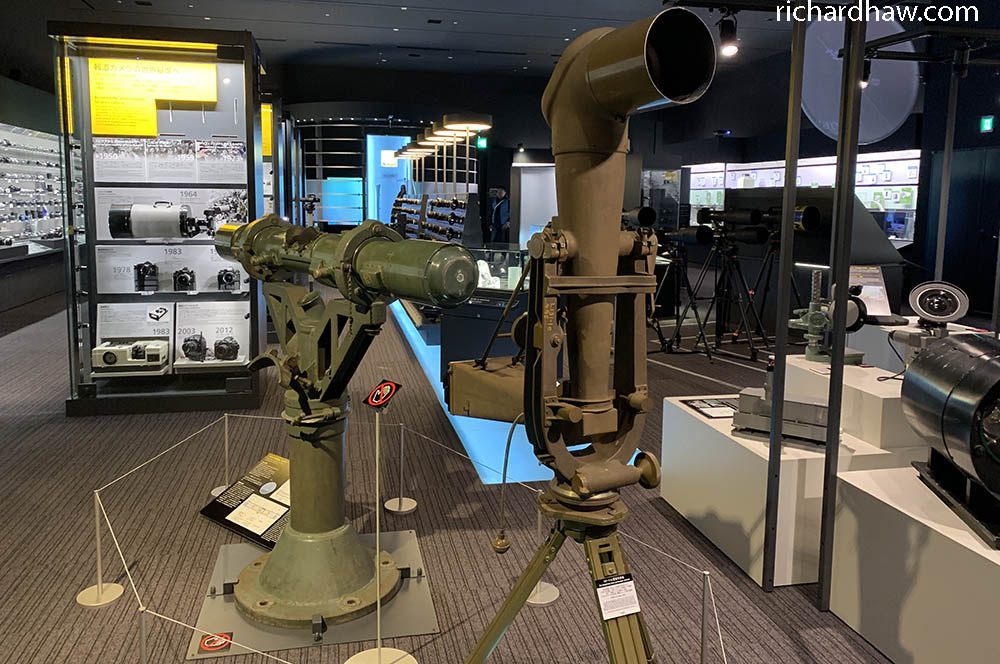 This part of the exhibit has some of the biggest items in the whole floor. They’re heavy so I was really careful so I won’t knock one of them over and make me the Mr. Bean of the Nikon world.
 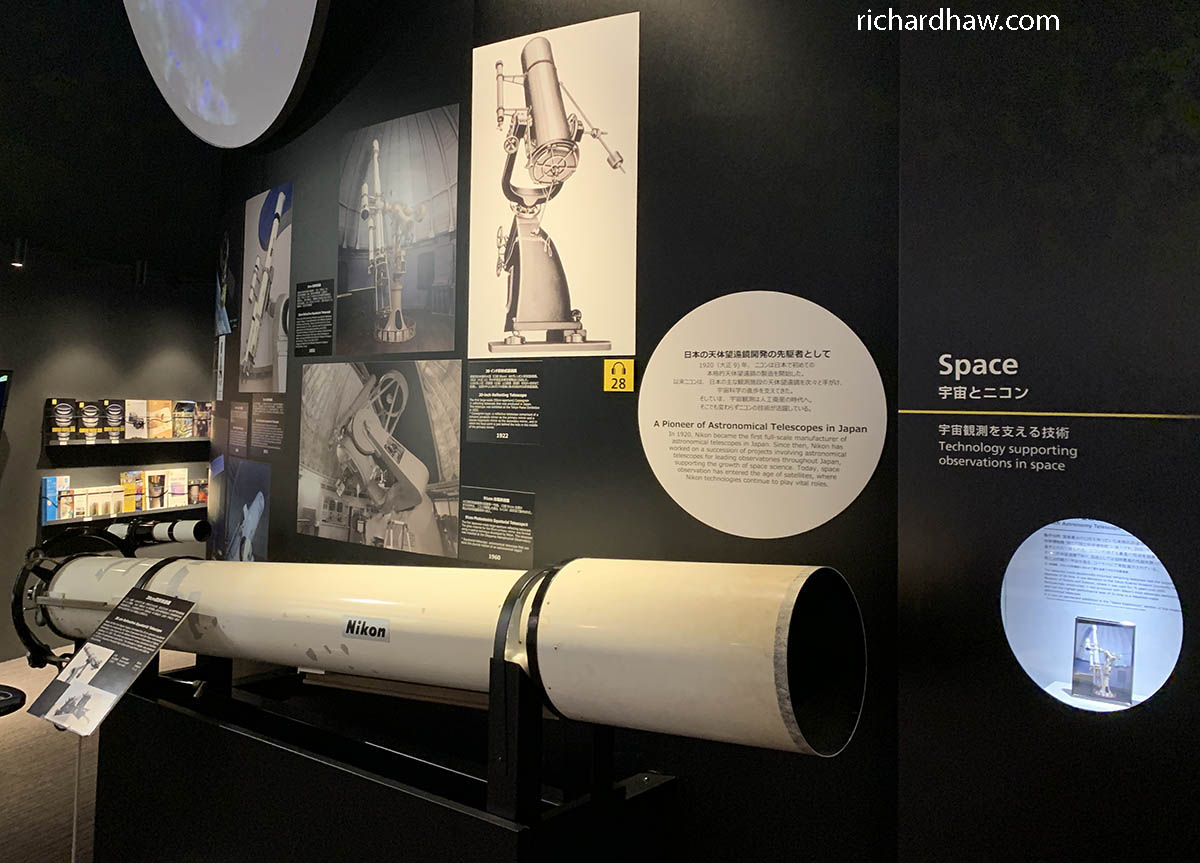 Nikon has a long history of making special optics such as this big thing, a telescope used for observing the night sky. This is one of the smaller ones and the ones at the picture at the back are its bigger siblings that are too big to fit the museum. This one is not part of the exhibit, it’s been in this spot for as long as I can remember but it fits the theme.
  The Nikkor 50mm f/1.4 Ai-S handles better than the Nikkor 50mm f/1.4 Ai. Its focus throw is shorter which allows you to focus faster with this lens. It was launched in 1981 to complement the Nikon F3 and it has sold close to about 800,000 copies (as of writing) according to
  Richard Haw's Classic Nikon Repair and Review