Hello, everybody! I was listening to “Freedom” by Wham!, it is a song about some guy who is so in love with this woman that he would forgive anything she does and basically let her have her way. Have you ever felt like that in your life before? I sure did, but that was many years ago. That feeling also extends to my love of vintage lenses, there is one lens that I have always wanted but I just can’t find a good version of it. Unlike the poor simp in the song, I will not waste my time looking for the perfect lens because there is one lens that is just as good and maybe even better. Do you want to know what lens that is? Read this article to find out more about it.
Introduction:
The Carl Zeiss Jena 50mm f/1.8 Pancolar it’s a magnificent lens, it needs no introduction. There are many versions that were made throughout the years but this is one of the best ones according to experts. I will not go through the complicated and long history of the Pancolar family because people are familiar with it, so it makes no sense for me to repeat what has been said by others. One thing I can say is this lens is a true legend and it deserves every bit of the hype about it. I was looking for a good substitute for a Planar, it has to come with an M42 mount and should be priced reasonably. My search led me to this instead but I am not disappointed at all because everything turned out well in the end.
The barrel is completely made of metal, it’s very sturdy and feels dense in your hands. It has a minimalistic interface, only having a focusing ring and an aperture selector. Finally, you have a little switch at the side. You can see it in this photo barely sticking out from the side of the lens near the left edge of the frame. It operates very nicely, the focusing ring feels very smooth to turn and the aperture ring clicks with a precise and reassuring feeling, something that a lot of Nikkors don’t even have, that’s because it uses a little ball bearing for the clicking mechanism.
Hello, everybody! Do you know Miyako Harumi (都 はるみ)? She is a celebrated Japanese folk singer who is popular from the 1960s up until today, she is an inspiration to many generations of singers. Her voice is very powerful and distinctive, exhibiting a wide range, it’s something that’s hard to match even to today. I think she is one of the best folk singers Japan has ever produced. Another striking thing about her is how small she is, despite her being tiny, she is able to channel such a powerful voice, something unexpected. I will show you something today that is tiny, and like Miyako Harumi, its performance is nothing small. Hear more about it in this article and see if you will agree with my assumption.
Introduction:
The Cine-Nikkor 50mm f/1.8 is a lens that was made for the 16mm format, I dare say that it’s probably the most popular of the C-Mount Nikkors due to its abundance in the used market. I don’t know when it was made but I can speculate that it ran from the late 1950s up until the 1970s judging from boxes and other things such as brochures and literature. There’s not a lot of information about Cine-Nikkors that can be found on the web, even the exhibit at the Nikon Museum about the Cine-Nikkors did not have everything that I need to date these little gems.
The barrel has the standard Cine-Nikkor design but it’s a bit shorter compared to some of its peers. It is a very well-made lens, the all-metal barrel is durable, the orientation of the mount can even be adjusted so you can see the engravings properly, just push the thread in and turn it to match your preference.
Hello, everybody! Do you feel like there are days when everything you see looks yellowish? I don’t, but I have heard of some people who do. Apparently, some people who suffer from internal disease will see things with a slight yellowish tint, as if wearing a pair of yellow lenses. It can be fascinating but it isn’t a joke or something to look forward to. The good thing is you don’t need to have this condition in order to see the world differently, I will show you something that will help give your photos a touch of yellow. It’s interesting so please read the whole article and click on the photos see what I mean.
Introduction:
The Reflx Lab 100 is a film that’s respooled by a company in China, which I try my best not to support if I can help it but I have already spent my money so here it goes. The good thing is at least they tell us what film they use, in this case it’s the Kodak Vision3 50D. Most companies that respool film won’t even tell you which stock their products came from so this is something good for the community.
It comes inside a metal canister which you can use to store weed or anything else, I don’t think that it’s necessary because it just adds to the cost of this product. The price is not so bad, in fact, it costs much cheaper compared to its rival.
Hello, everybody! Inflation is a big problem in this socialist country, the leaders have ran this country into the ground. It is affecting everyone, people skip meals just to get by because the price of basic groceries and shot up the roof. When fuel and food prices go up, everything else follows. In these trying times, it is best to be frugal. This hobby isn’t cheap and those who say that shooting film is cheaper than shooting a digital camera don’t know about economics. The good thing is there are always cheaper alternatives, you just need to know what to look for and where. In my case, it came as a surprise, more like an accident. It’s interesting and I’d like to share my findings with you. I’m not a “cheap-Charlie” but I welcome any form of savings, that’s just called being practical.
Introduction:
The Reflx Lab 800 is a film that’s respooled and marketed by a Chinese company in Shenzhen, I did not know about it at first but doing a bit of research revealed what I need to know about this company. It’s refreshing to see some newcomers into the market and it is interesting to know more about what they have to offer to the community. For this company, it’s cheaper versions of the products made by more established brands. They’re not entirely knock-offs but they have benefited from other people’s idea. In this case, it’s repackaged Kodak VISION3 500T Color cinema film. While the idea to do this is not theirs, I will applaud them for being transparent at least and state which stock their product came from.
It comes inside a metal canister which you can use to store weed or anything else, I don’t think that it’s necessary because it just adds to the cost of this product. The price is not so bad, in fact, it costs much cheaper compared to its rival.
Hello, everybody! Do you like watching “Japanese prawn” or “車海老”? I used to be an aquarist and these creatures are amazing to watch, they’re big and their colors are amazing. Needless to say, they are tasty. I know of a few varieties for preparation but my favorite is “tempura”. There are 3 main ways to prepare the meat, tempura, sushi and salt-baked, of the 3 major ways, the most popular one is tempura by far. Today, I will show you something that is also “big”, it also comes in 3 major variations. And just like the Japanese prawns, this is also something that you do not encounter everyday because it’s special, even expensive! It is also something to celebrate, stay a while and listen to my story.
Introduction:
The Nikkor-N 5cm f/1.1 was produced from 1956 to somewhere around 1959. It was Nikon’s fastest lens, only to be replaced by the recent Nikkor Z 58mm f/0.95 S Noct after more than a half-a-century’s time. It’s considered to be a breakthrough for the company in terms of lens design and mechanical engineering. Its reputation is such that it has earned a following over the years because for such a long time, Nikon didn’t make a true successor for it, with the next-fastest one being the Nikkor 50mm f/1.2 Ai. Sure, Nikon made the Nikkor-S 55mm f/1.2 Auto but it isn’t a 50mm “normal” lens, so most people do not consider that lens as a true successor. While the Nikkor-N 5cm f/1.1 was hailed as a breakthrough, it was merely a response to the world’s then fastest lens – the Zunow 5cm f/1.1 which came out a few years earlier. That lens sent a big message throughout the optics industry, and of course, Nikon had to respond.
We are going to look at the “external-mount” version of this lens, it has 3 known variants which we’ll talk about later. The barrel’s engineering is surprisingly modern, it has a focusing unit and the front barrel will not turn as you focus, unlike the internal-mount 50mmNikkors. The aperture ring is at the front, closer to the tip of the lens, while the focusing ring is situated at the center. The aperture ring is not evenly-spaced, a typical limitation of many older lenses. The attachment ring is 62mm, it’s best to only use Nikon’s filters of the same period because of the threads and position of the glass, using something else may scratch its front element since it’s too bulbous.
Hello, everybody! Do you know what is a “Billiken“? It’s The unofficial mascot of Osaka but with American roots, it was said that rubbing the feet will bring you good luck. His devious smile makes him appear a bit naughty and mischievous, but that’s just how he is. He said to be the god of “things as they ought to be“, helping you accept the trials of life in a more light manner. Today, I will show you a lens that will help you accept things as they are, it has its imperfections but they’re not so bad as to the degrade the photos you take, it’s kind of Zen-like shooting with this lens using a film camera. Read the whole article to know what this lens is all about.
Introduction:
The W-Nikkor•C 3.5cm f/2.5 came in two distinct mounts, one for the native Nikon S-mount and another for the Leica Thread Mount, this article will showcase the latter. This lens family was made from 1952 up to 1959, while the Nikon S-mount version was made with multiple variations, the Leica fit one came in two minor variations, one with a silver focusing ring and another with a black focusing ring, that’s it. These are highly collectible not only because of their importance in Nikon’s history but also due to their practicality. I think this is the most practical W-Nikkor, it’s really good for many things. It’s a very popular lens so these are not rare at all.
The barrel is all-metal, made from top-quality brass, that makes the lens heavy despite being compact. It’s not a big lens at all and you can hide it inside your palm. The engravings are helpful and clear, making the work of focusing much easier.
Hello, everybody! Do you like eating durian? I love it a lot but it’s not for everyone, it’s an acquired taste so it may take some time for your palate to accept it. Some say it’s sweet and tart while some say it also reminds them of vomit in the way it smells, the texture is also reminiscent of rotting flesh to them. I don’t see it as such, for me, it tastes and feels like exquisite cheese. You can debate with everyone about it but food is a matter of taste, just like how Joachim Loew (the German coach) like his own snot. Today, we shall look into something that is a bit confusing to me, I just don’t know what to make of it, is it good or is this trash? Join me today as we look into this confusing topic.
Introduction:
The Cinestill 400D is something that I have always wanted to shoot with but I was always indecisive, it’s not cheap at all and that’s one of the main reasons why. At one point, my curiosity had to be scratched, so I bought 2 rolls of this stock to review. As far as I know, I don’t recall seeing this film in Tokyo when I was still living there 2 years ago so this must have been sold just over a year ago or somewhere around that period.
Cinestill likes to color their film based on its perceived characteristics, purple suggests that it has a warm tone, leaning towards magenta or amber. The purple theme is cute, making it very appealing to younger customers and intrigues the rest, too.
Hello, everybody! Smart phones are getting bigger these days. It used to be opposite, I remember how phone brands were trying to make smaller and smaller phones each release. I sometimes think that it may be time for the smart phones to get smaller for portability. The downside is it will be hard to read my blog so it may be better to leave them the way they are. There’s something that we can miniaturize without losing any functionality. Wrist watches, wallets, etc. Today, I’m going to show you one of those things that gets better as it gets smaller. It’s not my favorite but I certainly like it.
Introduction:
The Nikkor 50mm f/1.8 Ai-S has a big following because it is Nikon’s smallest 50mm lens. It was made from 1980 to 2005, it had a long production run. It’s preceded by the short-lived Nikkor 50mm f/1.8 Ai-S (long-nose). If I recall, its optical formula is different and that allowed it to be more-compact. Despite being small it could perform quite well so it soon became a favorite of many photographers.
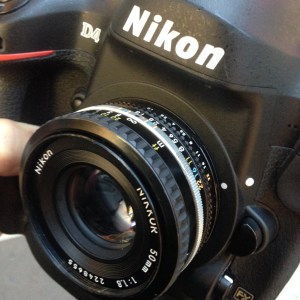
I remember that you could still buy these brand-new some 12 years ago. Its price has remained steady since there’s always a demand for it. Despite the hype and novelty, I don’t think of it as extraordinary apart from the fact that it’s small. It’s dwarfed by the Nikon D4 which can make handling awkward as you can see in this photo.
We had a lengthy commentary on screws and drivers on the previous post, the next important subject to consider is lubrication. If you’ve read any of Nikon’s repair manuals you’ll see that Nikon uses different types of grease and lubricants on different parts of their lenses and cameras. While this is the best practice in camera manufacturing, it isn’t practical for DIY repair for a lot of reasons, some of which are:
It is expensive to keep an inventory of various lubricants.
It is not cost-effective if you are just fixing your own stuff.
You may accidentally mix lubricants.
With the above considerations outlined, we will now start discussing about the most important lubricants in camera and lens repair.
Preparation:
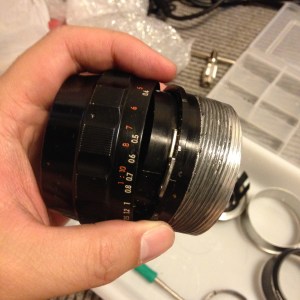
Before applying fresh grease to your helicoids you’ll definitely need to clean the helicoids first and remove the old, dirty grease. This is also true for any camera and lens parts that once had lubricants applied to them.
Just take a look, looks like the grease has not been replaced since 1965! This has to be cleaned and never leave any residue.
In the previous article we’ve outlined most of the essential tools for repair and maintenance of classic Nikons and Nikkors. Now, we’ll be discussing the best application for these tools so that you’ll less likely to destroy your gear by stripping or snapping a screw.
Just like everything else in life, you may mess up in your first few projects and that is okay. In my case, I messed up a few projects since there are not a lot of online material for this and any useful information out there are scattered or can be irrelevant at times. The lack of proper tools when I first started is a big contributor to my failed projects since I thought that it would be as simple as fixing a kitchen appliance. The good thing is I have managed to fix the failed projects now and I’ll show you how to prevent messing up your project from my experiences.
This guide isn’t going to be organized in any order, I’ll be updating this from regularly as I find new ways or remember anything that I have done in a previous project. A good deal has already been discussed in the previous article so please refer to that as well and I will try not to repeat anything that can be found there.
Help support this site by donating to richardHaw888@gmail.com over at Paypal! If you want to buy me a beer or a roll of film then that would be great,too!


 Richard Haw's Classic Nikon Repair and Review