Hello, everybody! Do you remember the show “Small Wonder“? I loved that show when I was younger, life was a simple back then and shows like that was enough to entertain anybody. We weren’t as fussy back then and we just accepted a lot of things. I guess that’s just how things were back then. I don’t think I’ve lost that since I am still satisfied with many things in life today despite the inconvenience. Today, I will show you something small. It’s really a “small-wonder” and I am also entertained by what I get from it despite not technically being excellent. It was made for a different time if you think about it, a time where things were much simpler than what we had 40 years ago. Read this article to see what this thing is.
Introduction:
The Cine-Nikkor 13mm f/1.9 was sold around 1953 to an unknown date, it’s notable for being sold with the Japan’s first 8mm motion-picture camera. It was replaced by the black-barreled Cine-Nikkor 13mm f/1.9 which is more common. It is an interesting lens with a lot of history behind it but not a lot of information could be found since the market at that time was dominated by European brands so there’s not a lot of literature left for us to reference from. What I do know is it was sold together with the Cinemax 8A made by Uryu Seiki in 1953 as a kit until the latter began to make lenses of their own. It was common for many Japanese manufacturers to include Nippon Kogaku lenses with their cameras at the time until they get the ability to design and manufacture their own optics, one example of this is Canon.
It’s all-metal, which makes this feel dense when held in your hand. It’s amazing how much detail went into building this little gem, the beautiful engravings are informative but difficult to see thanks to the shiny chrome-finish. It’s so tiny, the rings can be hard to recognize at times and you could be turning the wrong one if you’re not looking at it.. The front is recessed so a hood isn’t necessary.
Hello, everybody! Do you know about the “vintage-look”? It’s something that many people use these days to describe how a lens renders a scene. This term mostly gets thrown-around when talking about older lenses because they were not made to be optically-perfect. This was done either deliberately or simply because the technology of that time was not able to accurately calculate rays as fast as the engineers wanted or the manufacturing techniques just wasn’t there yet. While this trait is considered outdated by many people there’s a small group who seek these traits, mainly people who are into shooting movies. It can be used for storytelling and other creative pursuits. Experts say that your taste for the “vintage-look” increases as the adjectives used to describe your coffee gets longer. I beg to disagree because I am merely a Nescafé drinker but I appreciate a good lens with the said trait. Today, I am going to show you one such lens. It produces imperfect photos which can lead to expanded creative expressions. Read this article to know what this is.
Introduction:
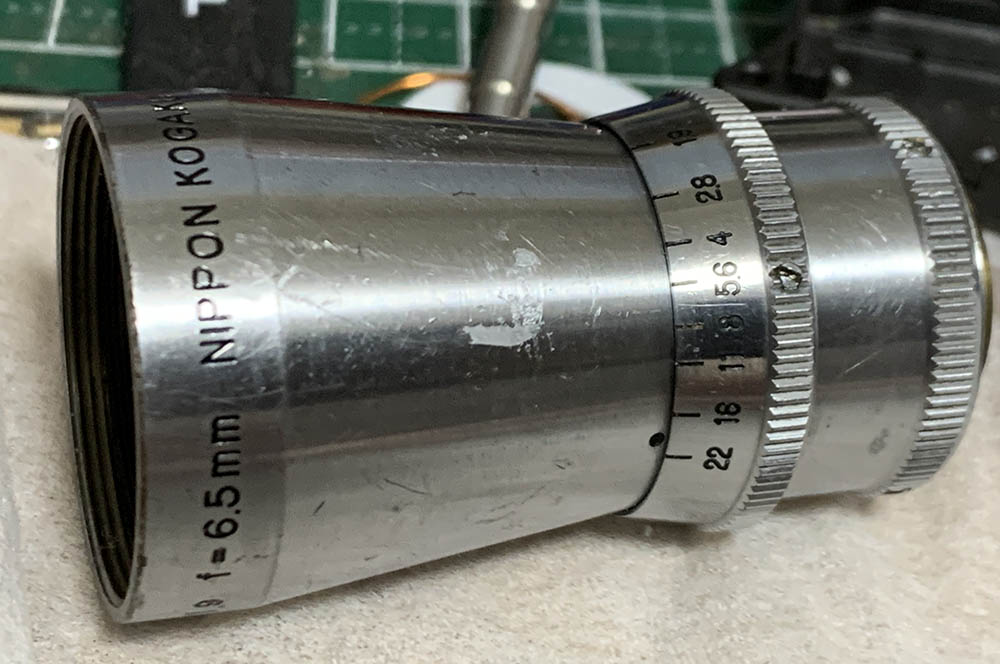
The Cine-Nikkor 6.5mm f/1.9 was introduced in the 1950s to capitalize on the 8mm movie cameras boom of that time. I do not know much about this lens since there aren’t many literatures about this. While 6.5mm sounds wide if you are coming from a standard 35mm perspective it’s actually considered to be rather moderate in standard 8mm. You’ll get an equivalent of about 36.5mm in terms of field-of-view with a full-frame (35mm) camera. The maximum aperture also sounds fast but it’s actually a lot slower than that. This is the reason why f/1.2 or even f/1.0 ones were common for the standard 8mm format but even with those speeds they won’t mean much when compared to larger lenses made for a bigger format such as standard 35mm.
The styling is similar to many European lenses of its class along with the decision to make it a fixed-focus lens. The lens is quite dense due to its brass parts and large front group. The aperture-range is from f/1.9 to f/22 and you use that for manipulating your focus via the depth-of-field. This is trivial since it’s considered to be a wide-angle lens so getting the scene in-focus should theoretically be easy. Stopping it down to f/8 will allow you to get most of your scene in-focus.
Hello, everybody! It’s spring now and it’s time for shopping. I rarely travel far lately due to the pandemic but if I do get to Ueno I always visit a particular shop which I will introduce to you in this article. They have a following because of the products they sell and to be specific, the quality of their merchandize. This is important if you want worry-free use, not all camera-lovers know how to repair old gear anyway.
Introduction:
Chikuka Camera (千曲カメラ) is one of the oldest shop in town which opened its doors in 1946. The shop is know for a lot of things such as the quality of their goods, the friendly and knowledgeable staff and what they have in the shop. It is not know for selling at bargain-level prices but their merchandize are all in great shape. If you want to buy a camera and just use it right out of the shop then this shop should give you that.
The shopfront is hard-to-miss if you’re in the area. Just like what the print at the awning says, they’re passionate about imported brands so this place should be on your list if you are looking for nondomestic cameras in Tokyo.
Hello, everybody! Let’s talk about something more simple. I have been collecting Cine-Nikkors lately and they’ve been all adjusted so I could focus properly to infinity. I will show you how I create my shims in this article.
Introduction:
Shooting with different systems sometimes require different methods to adjust a lens. The methods are vary from easy to difficult and at rare times even impossible depending on the situation. I’ll show you one method I use to achieve this and teach you how I make them. While making shims to adjust a lens’ focus is universal I’ll concentrate on using them to adjust the tiny D-mount lenses in this article and I’ll stay within that context. Do note that what you are about to see here also applies to other applications outside of adjust a lens’ focus and I will leave that to your imagination.
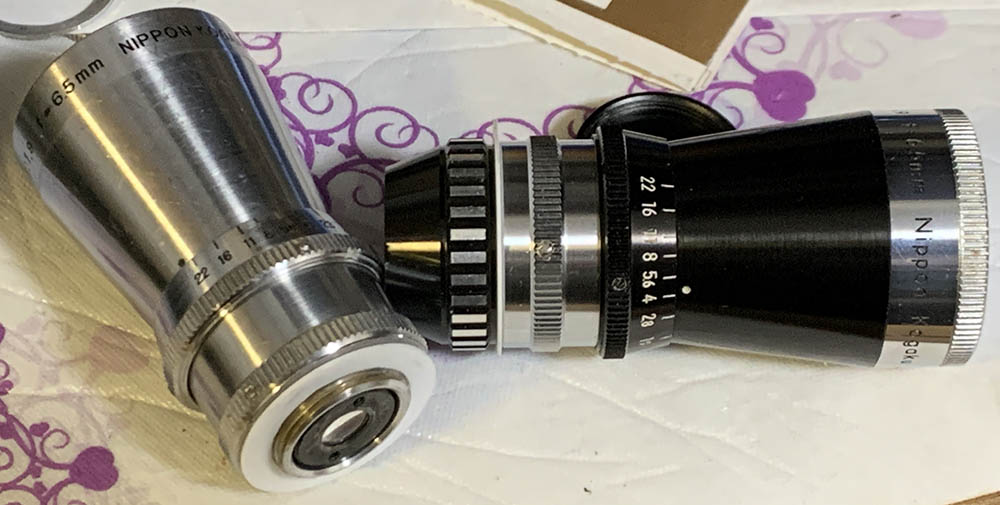
Here are my 2 Cine-Nikkor 6.5mm f/1.9 beauties. Both are fixed-focus lenses which means that there’s no way I’m able to adjust their focus apart from adding shims. Despite being identical optically and and barrels being similar in almost every manner these require shims that have different height with a difference of less than 0.1mm. You’ll have to make custom shims for every lens you own even if they’re of the same model and variation. Do note that the black one has a large cap at the rear and a front cap so it looks different from the earlier silver one. It’s important to note that the sizes of their accessory ring is different so they couldn’t share the same accessories such as filters and caps.
Hello, everybody! I’m always amazed at how smart my little girl is. She’s somewhat of a mascot when I go shopping for cameras and other junk since she occasionally tags-along, people associate her with me. The shopkeepers know her because they’ve been seeing her since she was a little baby, only a few-months-old. She sings a lot of songs, can draw quite well and very observant. It’s like she’s a teen in a preschooler’s body. Many small things amaze us, phones, bugs and other things. Despite being tiny they have a lot of things going on. Today, I will show you something small but size can be deceiving because this one has many features that many of its bigger contemporaries don’t. Read the whole article to know what this is.
Introduction:
The Pentax Q10 was sold in 2012, replacing the Pentax Q. The Pentax Q10 was replaced by the Pentax Q7 under a year later. I have always wanted to buy this but I did not want to divert my focus from Nikon at that time. It’s excellent and unique, the whole system punches above its weight in terms of features but sadly the whole series only lasted for a few years with only 4 models made. That made it so appealing back then but that wasn’t enough to make me part with my money. Fast-forward to 2021, these are now cheap and I also have a new alibi to purchase one – vintage Cine-Nikkors. The Pentax Q and the Pentax Q10 are your best options if shooting with D-mount lenses since they have sensors that’s closer to the size of 8mm (standard) than other interchangeable lens mirrorless cameras and you could get really close to the sensor with it just like what the D-mount lenses require since they’re made for 8mm. If you ever recall using one you will remember how close the rear of the lens is to the aperture of the movie camera, that is just about 9mm or so, maybe even less.
This is the tiniest setup I have, the Cine-Nikkor 13mm f/1.9 is really tiny but it compliments the Pentax Q10 well and the retro-look of the camera makes this even look more appealing. Using manual lenses with the Pentax Q10 is great since its features are comparable to that of many higher-end models or even surpass them. Features such as focusing-aids, manual-lens data input are very helpful. While the in-body shake reduction (SR) feature is nice I won’t use that feature much and I’ll explain that to you in this article.
Hello, everybody! I love a good Whopper, so much that I had a double (with cheese) last night after drinking several tall glasses of beer. The flavor of flame-grilled beef patty is hard to beat and the extra onions that I requested certainly did the job. I woke up in the morning with a mild hangover and my breath smelled of the delicious meal I had just before I caught the last bus home. I believe that this is the best way to enjoy a good burger, its value is hard to beat. Today, I’m going to show you something that has great value. Like the Whopper, many people love this lens and it will stay as one of Nikon’s best for the system that it was made for. Read the whole article to find out what this is.
Introduction:
The 1 Nikkor 18.5mm f/1.8 was sold from 2012 and it was discontinued when Nikon retired the Nikon 1 system. It was a popular lens when it was still being sold, that remains true even today as almost every Nikon 1 shooter owns one. Since this is 18.5mm you’ll get an equivalent field-of-view of 49.95mm which is practically the same as what you would get in a 50mm lens when shooting the 35mm or full-frame format. Despite that, you’ll still get the same characteristics of an 18.5mm lens when shooting with it and the nominal f/1.8 constant aperture will probably get you something closer to f/4.5 in real-world use. Even with that, this is still a “fast” lens and only the expensive 1 Nikkor 32mm f/1.2 will allow you gather more light to help the tiny sensor of the CX format in lowlight situations.
It’s a tiny lens, it’s light-weight but it performs great. The barrel seems to be made from anodized aluminum. This is the black version but it’s also available in white and silver. The mount appears to be made from a zinc or nickel-based alloy which feels like plastic but I am not sure about that. It has a grooved collar but it’s merely there for additional grip, this isn’t something that will turn despite looking like a focusing-ring.
Hello, everybody! Do you remember the short-lived LaserDisc? That was the only way to watch high-quality movies at a time when watching videos at home meant enduring an hour of watching so-so quality movies from a cassette. While I saw a lot of potential with the LaserDisc it only lasted for around 8 years or so because it was expensive and huge, the discs are so huge and delicate, scratching the surface or a single lint could stop what you’re watching. This is annoying if you’re reaching the climax. Today, I’ll show you something that’s obsolete but it’s more recent than the LaserDisc. It’s a failed system not because the idea is terrible but the people who make decisions certainly didn’t know what the users really wanted. Let’s see one of the best examples from this once-promising system.
Introduction:
The Nikon 1 J4 was sold from 2014 up to 2015, it’s one of the last Nikon 1 models to be sold. This was sold under the J-series which is the consumer-level bracket for the Nikon 1 system. It has a small 1″ sensor branded as CX by Nikon and these were made by Aptina. This format will give you about 2.7x crop-factor so a 10mm lens should be around 28mm if used with this system. This is an advantage if you like to shoot distant objects, mounting a 70-200mm full-frame lens is going to give you a 190-540mm lens in the practical sense since the field-of-view will be similar. The tiny sensor turned a lot of sensor-supremacists off, including me at that time but I now have a reason to enjoy it and that’s shooting using manual lenses. This article will focus on using this camera with manual lenses and how I would like to enjoy this system as somebody who repairs and appreciates old photography equipment and culture. And no, I’m not a hipster.
The only reason for me buying into the Nikon 1 system is to play with my Cine-Nikkors such as this Cine-Nikkor 10mm f/1.8 and the sharp Cine-Nikkor 25mm f/1.8. It’s a lot of fun shooting with these but it would’ve been better if only the Nikon 1 cameras could support the important features that matter when shooting with manual lenses without the need to use a Nikon FT1 adapter. With that gadget you will be able to get focusing-aids along with aperture-priority mode. I think this is one of the biggest reason why this system failed in terms of sales since its main rival, the Micro 4/3 system did everything right. The Nikon 1 system was promising and it had a huge potential but Nikon’s management was not thinking right at the time and some of that attitude still lingers on today.
Hello, everybody! I was watching some old pre-war clips, I did that to learn more about how it was back then, How we used to behave and think, what people did or ate, things of that nature. I am always fascinated by how much we have changed throughout the decades. Our standards are a lot more different today, what was deemed acceptable then is now taboo and what was cool is now treated as novelty by the majority. Today, I will show you something that used to be cutting-edge for its time but is now considered a relic of a bygone era. Despite not being relevant anymore I think it is still worth studying it so we will appreciate how fare we’ve gone since the early days of SLR photography.
Introduction:
The Zoom-Nikkor 85-250mm f/4 Auto is the successor to the legendary Zoom-Nikkor 8.5-25cm f/4-4.5 Auto, that lens is the first Japanese-made zoom and the 2nd one ever-made for the 35mm format. That’s a historically-significant lens but Nikon thought it could be better so this one was made. It was sold from 1969 to 1973, a short period compared to the older Zoom-Nikkor 8.5-25cm f/4-4.5 Auto which was sold from 1959 to 1969. It’s obvious that the Zoom-Nikkor 80-200mm f/4.5 Auto that’s introduced in 1969 is the more practical model so its production was halted. The Zoom-Nikkor 80-200mm f/4.5 Auto is smaller, lighter and cheaper to produce, I don’t think there’s any way you could argue with that.
The combined focusing-and-zoom barrel is handy because you could operate it with one-hand. This is what I’d call a “pumper-zoom”, I like this setup when shooting with manual-zooms specially for taking action photos. It needs some time to get used to if you’ve never used one. A Nikon Df is great for shooting with it since you can use pre-Ai lenses with it.
Hello, everybody! Are you old enough to remember the so-called “bubble-economy” of Japan? It was a time of wanton spending, a time when bar hostesses from Tokyo had the money to fly to Sapporo just to eat ramen there and fly-back to work in the same day. It was a false-economy and it won’t last long when the bubble burst. That was a time when people realized the value of money. The attitude became more grim as people turned-back to their old, frugal ways to make the most of what was left. Products began to be made with budget as the biggest concern and companies began to look elsewhere to spread their profits. Today, I’ll show you a lens that was a product of that era and how it has evolved into an even-cheaper version of itself elsewhere as Japan had to find ways to manufacture her products cheaper. The bar hostesses will have to survive on instant ramen from then-on, no more Sapporo ramen for you, miss.
Introduction:
The AF Zoom-Nikkor 35-80mm f/4-5.6D was sold from 1994 to an unspecified date but some sources claim that this was sold from 1993 to 1995. It was soon replaced by the cheaper and more flimsy AF Zoom-Nikkor 35-80mm f/4-5.6D (N) in 1995 but both were sold at the same time and were bundled with different cameras. The earlier ones were made in Japan and the later ones were made in the same Thai factory that made the latter one. Despite sharing the same name, both lenses share different optical formulas, even within this very version there are 2 different subvariants, the earlier ones have a different optical formula while the later ones have identical optics to the plastic AF Zoom-Nikkor 35-80mm f/4-5.6D (N) but the exterior design of the barrel looks the same. To make things clear, this one is the earlier version with its older, simpler optical formula. Things aren’t what they seem in Thailand, this is a bit difficult to identify if you’re a novice and the best way is to look underneath to see if it is indeed what you think it is.
It’s a compact lens and it’s not heavy, too. This makes it a great lens to bring on a trip but its slow-speed means that it’s limited only for shooting under ideal lighting conditions. The build quality won’t match the earlier all-metal Nikkors but it will survive a use in the field so long as you take care of it. Compared to the AF Zoom-Nikkor 35-80mm f/4-5.6D (N) that replaced it, this one has more metal parts, the most important being the bayonet. It won’t break into pieces when you accidentally drop it or bang it against a hard surface. The focusing ring turns as it operates so you should keep your fingers away from it when you’re shooting with it.
Hello, everybody! Do you shop online? The products you see may look great but they look different once you have unboxed it. It’s amazing what presentation can do to enhance a product’s image. Internet hype and rumors can make a shabby product turn into the best one ever made. This is why influencers make money. I was approached once to be an influencer for a lens company, I turned it down because I didn’t like how they treat their employees. Money and influence aren’t everything for me and I won’t sell my honor just for those. Today, I’ll be showing something to you that has been hyped on the internet thanks to these so-call influencers. I am going to review it for you and see if the hype is actually true or not. Let’s search for the truth together in this article.
Introduction:
The Nikon 135mm f/2.8 Series-E was sold from 1981 to 1985. It was made to complement the Nikon EM under the trade-name of “Series-E”. The lenses under the Series-E brand were made to be cheap but still retain a respectable amount of optical performance in order to be appealing to new photographers. Many Series-E lenses are quite good optically despite having lesser performance or build-quality compared to the true Nikkors, only missing the points due to poor coatings and a cheap-looking rendering. Despite all that, many people still hold-on to them because of the value they represented. Unfortunately, the hype has gotten a bit too much so they now cost more than their Nikkor counterparts. Of all the overhyped Series-E lenses this one gets the prize but it’s justifiable as its performance is quite good, rivaling the image quality of the Nikkors.
The build is decent but nowhere near Nikkor standards. Despite that, the plastic parts are durable and I think it will endure abuse in the field to some extent. The focus-throw is just-right if you ask me and handling is superb. It’s light and compact, It is the smallest 135/2.8 that Nikon has ever made. One funny thing about this lens is it was never sold within Japan and is considered rare locally. I have always wondered why but it seems that Nikon had a policy of not selling Series-E lenses in the domestic market if there is an equivalent Nikkor being sold at the same time. This was to prevent any conflicts in sales.
Help support this site by donating to richardHaw888@gmail.com over at Paypal! If you want to buy me a beer or a roll of film then that would be great,too!





 Richard Haw's Classic Nikon Repair and Review