Hello, everybody! Do you like Charles Bronson? I like his movies, he broke the stereotype that leading men in movies all should be handsome and flawless. He showed how a regular-looking man could also have the same impact and give a movie something special. He inspired a lot of “flawed” heroes in our current movies and showed everyone that you do not need to look perfect to do a great job. Today, I’ll show you something that’s not perfect but it could certainly do its job with no problems at all.
Introduction:
The new NIKKOR Z MC 50mm f/2.8 was recently announced and it created a lot of interest, including mine. This is due to the fact that the AF-S Micro NIKKOR 60mm f/2.8G ED is already long-in-the-tooth and its replacement is overdue by several years. I wasn’t expecting to see a 50mm Micro-Nikkor, the last one that has that focal length is the first version which is the venerable (and rare) Micro-Nikkor 5cm f/3.5 of 1956. That is a big deal because 50mm should be ideal for a lot of things like product photography compared to the slightly-longer 60mm that we’re now used to.
It’s a compact lens, I was expecting this to be sold under the “S” line but it seems that marketing thought that this one ought to be a tier lower compared to the premium lenses. I don’t know the reason behind this but it is what it is. This is not an issue for me because that means there might be a chance to see another one which has better performance and weather-sealing in the near future.
Hello, everybody! Which Rocky movie is your favorite? I love the original one but part IV has a special place in my heart because Dolph Lundgren was there. It illustrated the rivalries between states during the Cold War, something my young readers won’t be able to comprehend. It was a nervous time even in the 1980s just before the former USSR collapsed. I recalled how weary I was because a nuclear war might happen anytime. I wasn’t born yet when it started in 1947 but I’ll introduce to you a witness to that. If this lens could only talk I would love to hear what it has to say about the stories it took just before the “Iron Curtain” went up. Let’s find out what this lens is all about.
Introduction:
The Carl Zeiss Jena Tessar 40mm f/4.5 was made so that the Contax S and the Ihagee Exakta could have a lens that will go wider than 50mm. These predate Harry Zöllner and Rudolf Solisch’s Flektogon so Carl Zeiss Jena had to improvise a bit just to satisfy the need to get wider. If you’re an avid follower of this site you’d already know that it was difficult to design wider-lenses for 35mm SLR cameras back then so optical engineers had to resort to a few stop-gaps until there were suitable designs that could deliver what the market wanted which resulted in a few oddball lenses. This particular lens was made in the late 1940s and it represented that.
Construction is very good, the parts fit precisely and the level of machining is exceptional. The all-metal barrel is shiny with a thin coat of clear varnish. The iris could be stopped-down to f/22 which is not possible with the later version as far as I recall.
Hello, everybody! I always love a great burger, last weekend I went to Kichijoji with my family and we all had burgers for lunch and dinner. For lunch, we ate at the biggest burger restaurant chain in the world and for dinner we had some great burgers from a new company which is the talk-of-the-town in recent months. Their patties tastes great, there are no extenders and the seasoning is all-natural and light which means you could taste the beef for what they really are. I loved every bite as the taste is clean on the palate. I won’t get tired of eating this classic comfort-food. Today, I’ll show you another classic, something that I never get tired off despite shooting with it many times over. Read this article and you’ll see what I mean.
Introduction:
The Carl Zeiss Jena Tessar 50mm f/3.5 came in many variations through the years that it was made, we’re going to talk about the one that was made from around 1950 to 1954 in the M42 mount. I consider this to be the epitome of what a true Tessar should be in terms of characteristics: sharp, small and reasonably well-corrected. It won’t be as desirable as the Carl Zeiss Jena Tessar 50mm f/2.8 or the Carl Zeiss Jena Biotar 58mm f/2 which are both faster but it has something special about it which you’ll see later. This was made as the budget 50mm from Carl Zeiss Jena, I saw an old catalog for Ihagee Exaktas and these were sold nearly 2x cheaper than a Carl Zeiss Jena Tessar 50mm f/2.8 and the most expensive lens in the 50mm range is of course the Carl Zeiss Jena Biotar 58mm f/2 which costs several tens of 1950s dollars more. There was a need for to ensure that every part of the market is represented and this one became the go-to lens for the professional or amateur who just don’t have enough money to buy the more expensive options.
It’s a beautiful lens and the build is solid. It was made during a time when consumer products were made to last. It has a lot of useful information engraved on its barrel to aid you in focusing with it. The front element is recessed so you’re not going to need to shoot this with a hood.
Hello, everybody! Do you know Nagabuchi Tsuyoshi’s (長渕剛) song “Kanpai” (乾杯)? It means “cheers” literally and it is a beautiful song about friendship and coming-of-age, things to celebrate in every culture. I love the lyrics a lot because it evokes a lot of complex emotions and memories that we all have while growing up and finally reaching a point when we’ll have to look-forward to bigger things and face the grand stage of our lives. Today, I will show you something that is somewhat of a breakthrough for one company, it signals their arrival to the big boys’ club, once exclusive only to the elite of the optics industry and it’s something to celebrate, too. For this, I say “kanpai”!
Introduction:
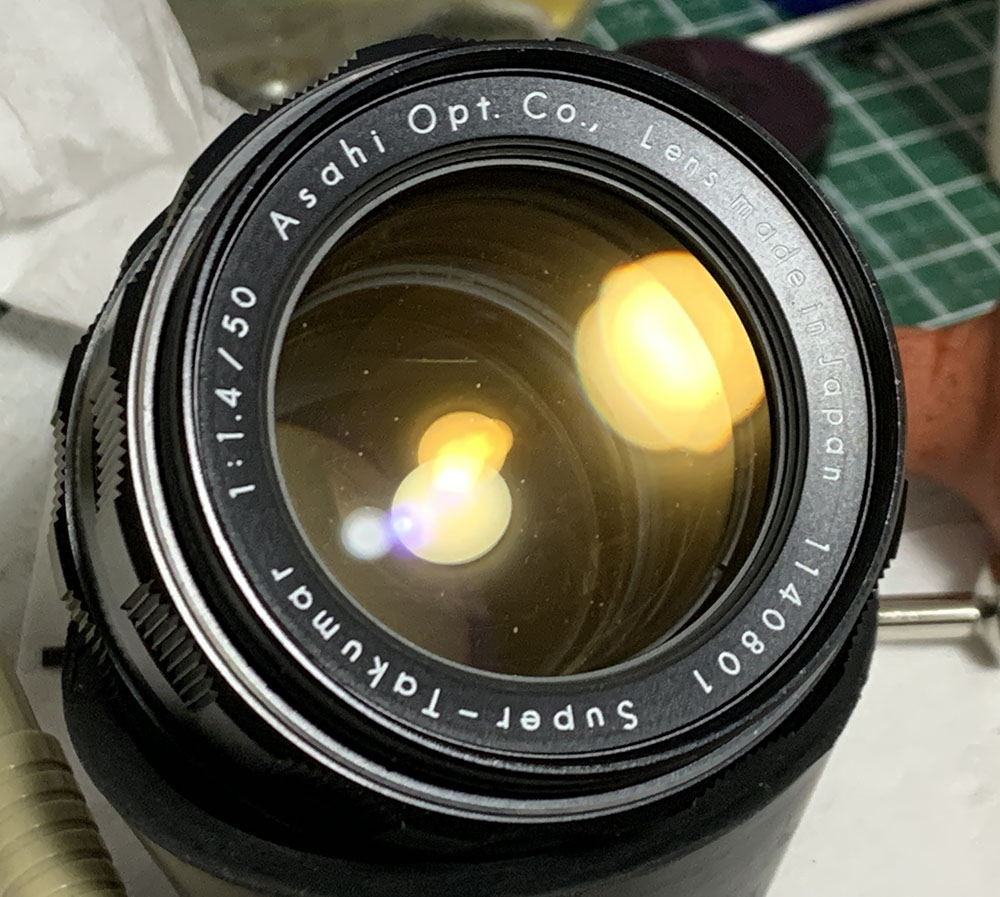
The Super-Takumar 50mm f/1.4 was sold 1964 to 1966, it was hailed as Pentax’s best lens and rightfully so because this lens performs rather well. Engineering a 50/1.4 lens at that time meant that you’re part of an exclusive few who could actually manufacture something so complicated for its time that many companies made it their mission to design their own. It’s now trivial these days but back in its day these lenses were considered the peak of optical engineering. Pentax achieved this despite having to work with several handicaps like the lack of capital since it’s a smaller company and the M42 mount which made it difficult to design more ambitious lenses due to its narrow throat. Pentax overcame all that, presenting us with a masterpiece. This lens has a huge following, it has certainly achieved cult-status. It’s very goof but we’ll see just how good this is in our article. Many people who’ve reviewed this are biased towards this brand so I hope that I will be able to present a more balanced view of this lens despite the fact that I secretly love Pentax, too.
It appears to be single-coated, with a deep-amber hue common with many Japanese lenses of the same vintage. This is a lovely lens with its deep-knurled rings. Handling can be annoying, the auto/manual switch could be easily adjusted if you’re turning the aperture ring since there’s no lock for it. Even if you’ve just nudged it a bit that is enough to alter its operation if you’re not aware of it.
Hello, everybody! Do you remember Fred Rogers? He is an amazing person who seem to see something good in all of the things that happen in this world. When an awful situation happens it’s nice to remember him and his show. There’s also a good story by Ajahn Brahmawanso about how he almost destroyed a brick wall just because there’s brick that’s not looking quite right. What stopped him was the thought that it’s not worth destroying a whole wall just for a single brick since the rest are obviously fine. In this life we’re sometimes faced with annoyance and it’s important to see some good in any situation. Today, I will show you a similar situation, I’ve received an item that is in otherwise good state but it has a blemish. Since it still sort of works fine I just focused on that fact instead of that blemish.
Introduction:
The Cine-Nikkor 13mm f/1.8 was sold from an unknown date. Judging from the types of the boxes I’ve seen these were probably sold from the 1960s to around the latter part of the 1970s and even possibly up to the 1980s. I’ve seen beige and even blue boxes for these. This lens filled an important part in Nikon’s C-mount lens catalog, it gives you a similar field-of-view of a 35mm lens on full-frame. While f/1.8 may sound bright it’s actually rather dim, being merely an f/4.8 lens in actual practice. You’ll have to remember that the 16mm format is smaller than 35mm so it gathers less light and you won’t get shallow depth-of-field with it unless you used a super-fast lens.
The barrel is engraved with all sorts of informative scales that will be useful for operating this lens. The mount is special in the sense that you can adjust its orientation so the centerline of the barrel will be visible to you. This is essential, not all camera brands will allow you to mount these lenses similarly so the ability to adjust its orientation is important.
Hello, everybody! The pandemic has affected every person I know, mostly negatively. It has certainly affected our craft, we now have less opportunities to take photos. This sort of dampened my passion so I’m restricted to taking boring or repetitive photos. I’ve recently discovered a new film which I haven’t used or heard yet. It’s not expensive but it’s not a cheap stock either so I thought that I’d probably give it a shot. To my surprise, it’s actually rather nice and it has helped me enjoy photography again.
Introduction:
Today, we’ll take a look at Uchu-no-Katasumi (宇宙の片隅) or “A Corner of the Universe” in English. It’s made by Irohas, a small photography company based in Gunma, north of Tokyo. If you’re shopping for used cameras and lenses you’ve probably saw their name in the online auction sites. Click on this link to go to their website. This film is sold under their Yama brand, think of it as a Japanese equivalent of that big company that sells plastic cameras to people who pay a lot for a cup of drinkable cakes. Go to the Yama website to see what they’re all about.
What took my attention was the color of the box and its corny art. The name is also intriguing which made me curious. I was compelled to buy it because it’s priced decently at $6.50 for a 24-shot roll. I said decent since it should be sold at a lower price because it’s just 24-shots, if it’s 36-shots then you wouldn’t hear anything from me. I hate 24-shot rolls, I have to pay the same price to process and scan it compared to a 36-shot roll.
Hello, everybody! I’ll share with you my experience about bleaching thoriated glass and show you some results. This is a topic that has been discussed many times but I’d like to contribute my experience to my readers in case you want to hear what I have to say.
Introduction:
The use of radioactive glass is controversial for obvious reasons and I don’t need to explain why. But why did the use of radioactive material became an option for some manufacturers from the 1960s up until the 1970s? These exotic blends offer plenty of advantages since optical engineers could correct more aberrations with them, allowing them to achieve certain benchmarks or help design the “perfect lens”. Of course, public opinion put a stop on this practice which could have been influenced by the events at Long Island or some other things prior to that. I can’t say anything about any ill effects on us humans but it certainly will tint your lens with a yellowish or amber hue depending on how it was stored or how old it is. The “hot-element” can alter its own composition at the atomic-level and result in a dark-core. It affects the performance of your lens by filtering light, at times depriving it of as much as 2-3 stops of light. It also affects how sharp it could render, too. The drop in sharpness won’t be obvious but it’s definitely observable to a minor extent. That and also a drop in resale value is something that you should be aware of.
This is how it looks like before treatment. The Nikkor-N 35mm f/1.4 Auto is the most notorious example in Nikkor-land, I couldn’t think of another Nikkor that suffered from this despite knowing of others that have slight radioactivity in the glass. Do note that the center of the glass looks more discolored compared to the edges, hence the term “dark-core”. I personally didn’t mind this since it somewhat made this lens special and the discoloration is somewhat remedied when you’re using auto-white-balance but that will never be the case when shooting with film.
Hello, everybody! Do you know “いとしのエリー” (Itoshi no Ellie)? It’s a popular love song by a Japanese band named “サザンオールスターズ” (Southern All Stars). The meaning of the song is beautiful, it’s about a love that turned sour somehow. The late Ray Charles covered it as “Ellie My Love“, the melody is the same but the lyrics has changed. It is still a great song despite many people thinking that Ray’s version is the original. Today, I’ll show you something that has been rehashed and just like the songs that I mentioned, both aren’t identical despite looking really similar. Let me present to you its ultimate evolution and the swan-song of this lens line.
Introduction:
The Cine-Nikkor 38mm f/1.8 replaced the older Cine-Nikkor 38mm f/1.9 around the late 1950s I assume. It’s last lens in the 38mm class of Cine-Nikkors and in my opinion, the best at certain scenarios. It’s apparent that the Cine-Nikkor line wasn’t the focus of Nikon at the time so we never get to see another one after this was made. Compared to the slower Cine-Nikkor 38mm f/1.9 this one is marginally faster. I am not sure how useful that is but I suppose that was developed for marketing purposed and f/1.8 makes it more practical because that’s what many light-meters show in their dials.
Handling is excellent, it’s not difficult to distinguish the rings with your fingertips. The all-metal barrel makes it a robust lens that could survive use in the field so long as you’re careful with it and prevent dust and moisture to foul the barrel. The numbers can be difficult to see due to their size but it’s a lot better compared to the early Cine-Nikkor 38mm f/1.9 which was made with chrome barrels.
Hello, everybody! Most of you have noticed that I have been buying some Pentax gear lately. That is because I love the brand, second only to Nikon, of course. For others who love Pentax, I will introduce to you a new shop that has a lot of Takumars, probably the most number of them in a single shop. Not only that but it’s also what I’d call a “concept shop” because it’s a maverick in terms of presentation, it’s not your usual moldy and dank camera shop manned by greying gentlemen.
Introduction:
2nd Base is a shop under the Sanpou Camera group which I have previously introduced to you. It’s their trendy shop at this part of town. They haven’t been open for a long time but they do have lots of customers because they have all the amazing things a film-lover would like, from used gear, film and even chemistry. This is a small corner of film-paradise, a great place to kill your time and get what you need.
This is a well-stocked shop. It looks more like a boutique than a used camera shop. The interior looks trendy with all of the industrial-theme-inspired shelves and displays. It’s probably been in business for less than 2 or so years.
Hello, everybody! I am going to introduce to you one of the shops that helped me begin my repair adventure. I bought a Micro-Nikkor-P 55mm f/3.5 Auto from their junk shop and the shopkeeper told me to just repair it. Since I had plenty of time then and knowhow from my previous hobbies and profession I took a stab at it. That is one of the reasons why I started this blog.
Introduction:
Nisshin Camera (にっしんカメラ) is an institution in Akihabara, it’s operating for decades and is one of the best shops in this side of Tokyo. I rarely visit this shop since it’s a bit inconvenient for me but I would come here every time I am in the area.
This is the shopfront, it’s difficult-to-miss, specially with that big Fujifilm sign. It looks small from the outside but you’re going to spend plenty of time inside because their inventory is quite good despite the small location. There used to be another shop some 30m away which only sold junks but that shop closed a few years ago.
Help support this site by donating to richardHaw888@gmail.com over at Paypal! If you want to buy me a beer or a roll of film then that would be great,too!




 Richard Haw's Classic Nikon Repair and Review