Hello, everybody! Do you remember Chen Kenichi (陳健一), the “Iron Chef“? He is the longest-serving of the group, who were originally three (later four) – Chinese, Japanese, French and Italian. He is one of the original chefs and had the most record, wins-or-loses. Unfortunately, it’s with a sad heart that I announce to you his death, he left us a couple of months ago this year. Such a legendary chef with a long career. So, for today’s article, I am going to introduce to you a lens that has the longest production amongst all of its siblings, and just like the “Iron Chefs“, it’s part of an original trio, but was joined by another one later. This is considered to be one of the best in the whole family, befitting to be likened to the late Chen Kenichi.
Introduction:
The AF Zoom-Nikkor 80-200mm f/2.8 ED (N) is the last version of the venerable 80-200/2.8 ED family that has the original optical formula. It was made from 1997 and only finished its run in 2006, a very long time for a professional zoom, even surpassing a few of its successors. It came about after feedback from many photographers that demand a 2-ring setup and the very important tripod foot. It’s one of the evergreen lenses many people swear by, even to this day.
The first thing on will notice about this lens is how different it is from its older siblings. Compared to the AF Zoom-Nikkor 80-200mm f/2.8 ED and AF Zoom-Nikkor 80-200mm f/2.8D ED, this on has two separate rings, on for focusing and another for zooming. There’s finally the addition of a tripod foot, too!
Hello, everybody! Do you know “Nong Toom” (ปริญญา เจริญผล)? She is a legendary Muay Thai champion that’s known for her skills, but mostly known for being a “ladyboy”. Her story is so famous that there is a movie that was made about her titled “Beautiful Boxer“, where the tagline reads – “She fights like a man, to be a woman”. It just shows her dedication to her art and her wish to become a real woman. Inside the body of a fierce fighter is a woman trying to break free. An amazing paradox like no other. Today, we will look into Nikon’s latest classic, and just like Nong Toom, it is something that lives between different polar opposites, with a “big surprise” if you aren’t expecting it.
Introduction:
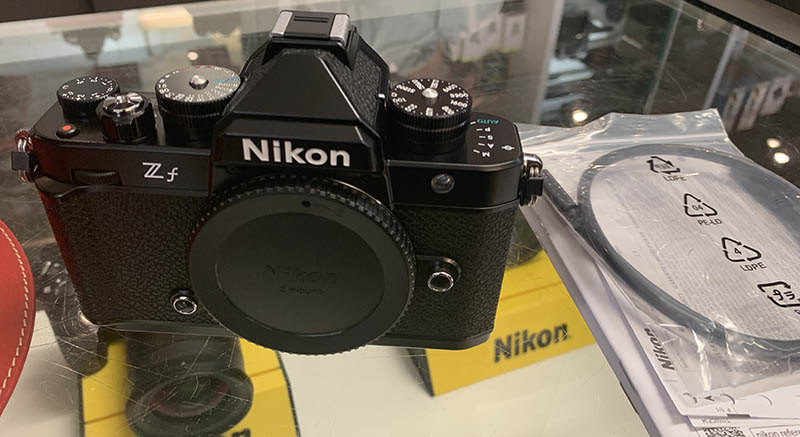
The Nikon Zf is the much-awaited FX version of the popular Nikon Z fc. The development of the Nikon Zf began not too long after the little Nikon Z fc was introduced, driven by the favorable response of the little brother. For those of us who are waiting for the true successor to the beloved Nikon Df, this is the closest thing we have, but in a mirrorless format.
It has the look of a film camera but it really is a state-of-art machine, even having features that advanced cameras like the Nikon Z8 and Nikon Z9 do not have. It is what I would call a “hobby camera”, something that you take out to shoot with because it’s fun, but it’s also capable of taking amazing photos thanks to its amazing sensor and processor.
Hello, everybody! I was watching “Blazing Saddles“, and I realized that the dialog Bart told Lili is gone! It went like: “I hate to disappoint you, ma’am, but you’re sucking on my arm…“, or something like that. It is in the scene where she unzipped Bart, eager to learn about how Bart’s people are “gifted”. Maybe that joke is too “raw” for modern taste, but for us who were not born recently, we don’t give a damn. I do not care for other men’s anatomy, as the character Lili Von Schtupp was with Bart’s, but I have something that will make you curious. And just like the common notion, this thing is just as long, black and thick, when you hold this in your hand, you will surely say: “It’s twue! it’s twue!“.
Introduction:
The Cine-Nikkor 100mm f/2.8 is an oddity in its family, it’s easily the longest one. Nobody knows when it was introduced, but I can guess that it was sold sometime around the mid-60s or the early-70’s, and was probably sold until the 1980s. There’s no data about when they were on the market, but just like most, if not all Cine-Nikkors, this wasn’t sold in your usual camera shop. I was told that these can only be bought from special retailers, which were sold in low-volume. Anyway, Nikon had to make this lens because of the need to have a long, telephoto in C-mount.
This is the longest of all C-mount Nikkors, it has an impressive barrel that handles quite well. It also has an informative depth-of-field scale, which I do not find all that useful. It is the only thing you will have when you shoot with a 16mm camera because you won’t be able to view through-the-lens. There is a finder for framing but that separate accessory won’t help you focus at all.
Bonjour tout le monde! This is my first article for a shop outside of Japan. I certainly miss shopping at the amazing shops and huge department stores of Japan so I was happy to find a shop that sells used photography equipment. Of course, the shops here will not surpass the quality of what you will see in Japan but this one is close enough. Please join me as I introduce to you one of the more established businesses in town, servicing the community since 1999.
Introduction:
Ciné Monde is a not-so-little shop located in a very hip part of town. It’s operated by Mike, who is somewhat of a celebrity among the local photographers. It’s one of the few camera shops in this part of the province and I was told that the items here move fast. I saw what they have and it’s decent compared to what I see in Japan, there are some interesting and rare stuff here, too.
This is the front of the shop. It’s hard to miss this place if you are walking but it may elude you when you’re driving because they do not have a big sign outside facing the traffic.
Hello, everybody! Many people today do not recall the glory days of the cassette tape. When I was young it was the only way we could affordably own a record that’s portable enough to be used as audio entertainment media for our cars. Before it we only have radios and we only listened to things that the DJ would play. Owning a cassette player in your meant that you can play whatever you wanted to listen. It was cheap, small and fairly reliable despite hassle of the tape being tangled inside the player. It took a very long time for the compact disc to be perfected which replaced the cassette eventually. There were many trial-and-errors, you’re not supposed to run fast when on uneven road or your song will skip since buffering wasn’t implemented yet and the inconvenience of having to store your CDs at the trunk or under the seats were annoying. Despite those setbacks, early in-car CD systems showed us the way to the future until the technology has been perfected in the late 90s. Today, I will show you something that reminded me of those days. It came in late because the established product was so reliable that it was difficult to replace but as soon as people had mastered the technology this soon became somewhat obsolete, being only remembered as a transition.
Introduction:
The AF-Nikkor 20mm f/2.8 came out in 1989 and lasted only shy of 5 years in production until it was replaced by the new but very similar AF-Nikkor 20mm f/2.8D. It’s the autofocus version of the popular Nikkor 20mm f/2.8 Ai-S, which outlived it by many years. Its introduction was somewhat late for an AF-Nikkor, probably because of how complicated the mechanisms inside of it are. It has the came CRC system found in the Nikkor 20mm f/2.8 Ai-S. You will see later how intricate the interior of barrel is and how clever the solutions are. Many people thought that this lens and the later AF-Nikkor 20mm f/2.8D are identical apart from the exterior but they’re not really exactly the same in terms of construction internally, with the later lens having more modern characteritics.
While the constructions is all-plastic, at least in the exterior, the lens has a solid feel when held. It may rattle somewhat when you shake it, maybe a little bit more than the usual AF-Nikkor but it’s not flimsy at all. Like all Nikkors of its kind it has a lock for the aperture ring so you can lock it at its minimum aperture of f/22 when using it with autofocusing Nikons. You’ll get an error if it was not setup like this. The focusing ring is of the later type since this was introduced a bit later compared to its contemporaries. It isn’t as wide as I’d like but it’s not pathetic at all.
Hello, everybody! Are you a fan of Prince? I am one of those who listened to his music in his prime when he was alive and one of my favorites is “Purple Rain“. Many people remember it because of its very long instrumental part. Back in the day when I used to go to stripper clubs I recall incidents when the dancer would get into an argument with the DJ whenever the latter would play this song. This means that she’d be dancing more than she should! Today, I will show you something that reminded me of my wild youth, and just like Prince’s masterpiece the prominent theme will be the color purple.
Introduction:
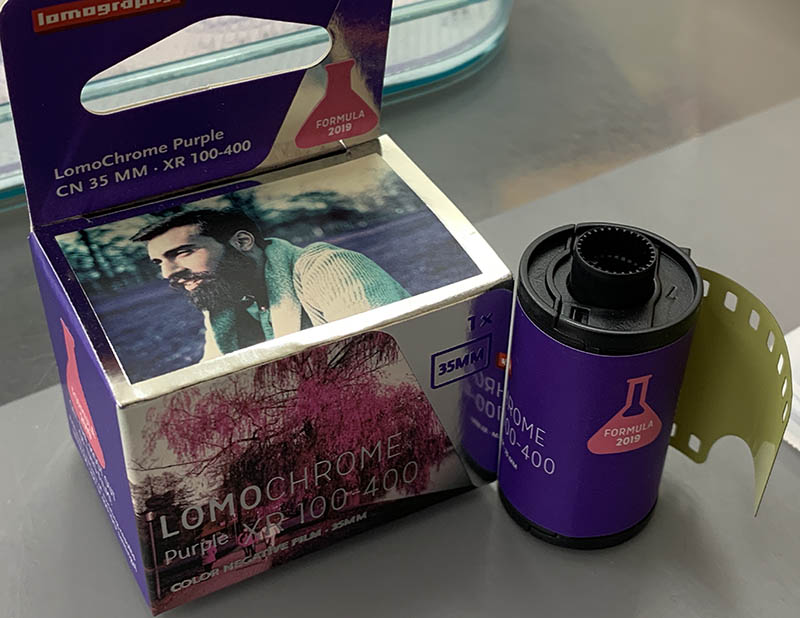
The Lomography LomoChrome Purple 100-400 is a variable ISO film similar to the Lomography LomoChrome Metropolis 100-400 but it turns things purple as the name suggests. I have heard of this film for a long time and I have always been intrigued by it but I’ve only shot with it recently. I think it has been around for about a decade, it has a strong following online amongst younger film photography enthusiasts because of the unique look it’s able to produce, which somehow resembles cross-processing in such a way that some colors shift their hues to the purple side of the spectrum.
The box looks nice and the film is encased in an equally nice plastic canister. What struck me the most is the color of the base, it’s yellow and kind of thick. It has 36 exposures, I don’t think these are sold in 24-exposure rolls. Be aware that this film doesn’t come with a DX code so you’ll have to dial-in your desired ISO manually or rate it somewhere within the ISO100-400 range for best results according to the box.
Hello, everybody! It’s been a couple of months now since I have left Tokyo in order to live elsewhere. It’s not easy to say goodbye to a place that I called home for more than a decade or 12 years to be exact. All the preparation and expenses made me stressed but at least my daughter might be happier here in our new home. I think it is fitting that I dedicate this post to Tokyo, an amazing city that had been part of my family’s life. Please enjoy this little article.
Introduction:
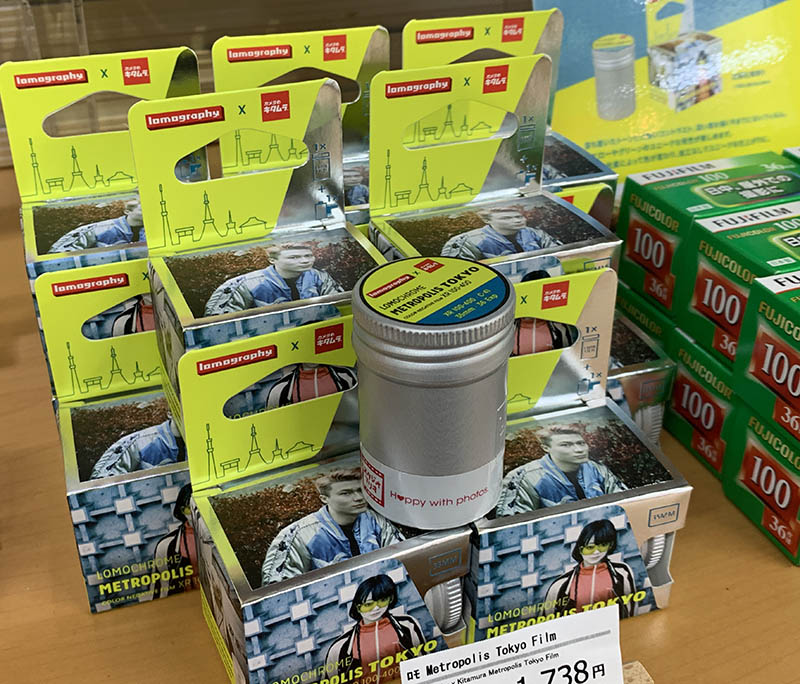
The Lomography LomoChrome Metropolis 100-400 (Tokyo Edition) is a limited-edition film made with the collaboration of Kitamura Camera in Japan a few years ago. As the name implies, it’s a variable-ISO film which means it can be used within the specified range and you will still be able to get good results which makes this a very forgiving film to shoot with. You can rate it however you want so long as you don’t stray too far from the recommended range. This is probably a repackaged Lomography Metropolis 100-400 since I could not see any difference with shooting both films. Maybe they just want to get rid of inventory that’s been sitting in the warehouse for years, I don’t know.
Unlike Lomography’s normal line of hipster films this one comes with a premium aluminum tin. Packaging is important for sales and brand-image and they went all-out this time. Do not be fooled by the pictures on the box, you’ll only get these results if you’ve shot the film under the right conditions and I will show you how you can get it or at least understand how this film behaves. There is a slight difference when you use it at different speeds and only at certain conditions.
Hello, everybody! Do you remember Sony’s tagline back in the day? If “It’s a Sony” doesn’t sound familiar to you then you must be younger than 35. It’s effective branding, it’s catchy and easy-to-mention. It’s an effective way to drill into your potential customers’ minds about your brand’s image and what that stands for. You’ll have to keep it short, simple and direct. Just repeat it like a jingle and it’s certainly going to stick to their head the next time they buy an electronic device. I will play on that slogan today but this time it’s not a Sony but “It’s a Sonnar“, a Tele-Sonnar to be precise if I’m not mistaken.
Introduction:
The Cine-Nikkor 75mm f/2 was made from an unknown date, nobody knew when it ended production. I suspect it was made from the mid-1960s up until around the 1970s. I was told that Nikon does not really document anything that’s not a consumer product so precise information about these can be scarce and inaccurate. These are specialty lenses so I guess they were made in low-volume which are spread across a long production time. This lens is the second-longest in the Cine-Nikkor portfolio for the C-mount, it filled the gap between 50mm and 100mm. It’s rather useful for wildlife, sports, news or just about anything that requires a bit more reach. You could think of it as the 200/3.5 equivalent for a standard 16mm camera as it gives the same field-of-view and depth-of-field characteristics of a 200/3.5 lens for 35mm. Crop-factor is a recent concept that’s not really relevant in the context of shooting movies but since we are interested in using this for stills you should always be aware of this.
Despite its focal length and speed it managed to remain quite compact, this isn’t larger-nor-thinner than the other ones except for the early version of the Cine-Nikkor 25mm f/1.4 which is an oddity. Keeping the size of the barrel uniform is essential so you could use your custom-made attachments. Its mount could be repositioned by depressing the thread and rotating it, allowing you to view the scales no matter which orientation it ended up in the camera. This is a nice touch, I am not aware of any other manufacturer that did this.
Hello, everybody! There are many classic movies that were remade in the past couple of years. Some were good but the majority is rubbish, never surpassing the originals in terms of impact and reception. I think it’s unnecessary to do remake great movies such as Ghostbusters and Willie Wonka and the Chocolate Factory because I consider them to be “perfect” but The Fly benefitted from an overhaul. Today, I’ll show you one such “remake”, unlike Ghostbusters this lens had to be updated and resulting lens is a lot better than the original. Read the whole article to know more about it.
Introduction:
The Cine-Nikkor 25mm f/1.4 is an upgrade of the older Cine-Nikkor 25mm f/1.4 with the smaller, old-style barrel. It has new optics and the barrel is now similar to the concurrent models such as the Cine-Nikkor 10mm f/1.8. I don’t know when this was made but I assume that production ran from 1962 up to an unknown date. It’s difficult to date these because there’s no data available. The only information available are from leaflets and there are no dates available. Regardless, it’s apparent that the older Cine-Nikkor 25mm f/1.4 had to be replaced for an unknown reason and this lens replaced it in the catalogs. It’s the premium option for a “normal” lens for the 16mm format and it gives a field-of-view close to 67mm if you were to consider its crop-factor. Crop-factor is a rather new concept, people who shoot movies don’t even think of it. It may sound like a super-fast lens but it’s sort of mediocre for this format and it’s not unusual to find lenses with an f/1.2 aperture for shooting with 16mm.
The barrel is built like most C-mount Cine-Nikkors, it’s solid and feels substantial despite being tiny. These were popular lenses so it’s not unusual to find these with scratches and heavy-wear. The scales are easy-to-read and you will need to rely on this when you shoot this with a 16mm camera. Focusing precisely without looking through-the-lens can be difficult but you’ll get used to it.
Hello, everybody! Do you remember Bobby Goldsboro’s old song “Honey“? It’s a sentimental song about a man missing his lover named “Honey” who left him when her time came unexpectedly. It’s a favorite song of many people but some think that it’s stupid due to this being a country song with simple, corny lyrics. I personally loved it and I occasionally sing that at the karaoke. There are many things in life that divide our opinion. Today, I’ll show you a lens that some people love but some people hated it. And just like “Honey” I think it’s “kind of dumb and kind of smart”, too. You’ll know later why I made that remark so please read the whole article carefully.
Introduction:
This version of the Carl Zeiss Jena Tessar 50mm f/2.8 was made from 1964 to 1967, it is called “zebra” by many people because it has a barrel that has striped rings. Unlike the older Carl Zeiss Jena 50mm f/2.8 Tessar the iris could be actuated automatically but it now only has a 6-bladed iris instead of the circular one of the older versions including the semiautomatic version. This lens used to be the best 50mm Tessar of its time and it was nicknamed “adler auge” or “eagle-eye” because its sharpness. While I think that the older version sort of fell-short in this regard I think this one truly lived-up to that nickname and you will see why soon.
The build is typical of Carl Zeiss Jena lenses from this era meaning it’s all-metal. the engravings are easy-to-see but the depth-of-field scale seems to be rather vague because they’re not color-coded unlike what we’re used to seeing with Nikkors. The aluminum barrel feels nice and it also helps to keep this light but it is still quite substantial when you hold it and not flimsy at all. There’s a small tab at the base which you’re able to depress in order to stop the iris down for depth-of-field preview or metering through-the-lens.
Help support this site by donating to richardHaw888@gmail.com over at Paypal! If you want to buy me a beer or a roll of film then that would be great,too!






 Richard Haw's Classic Nikon Repair and Review