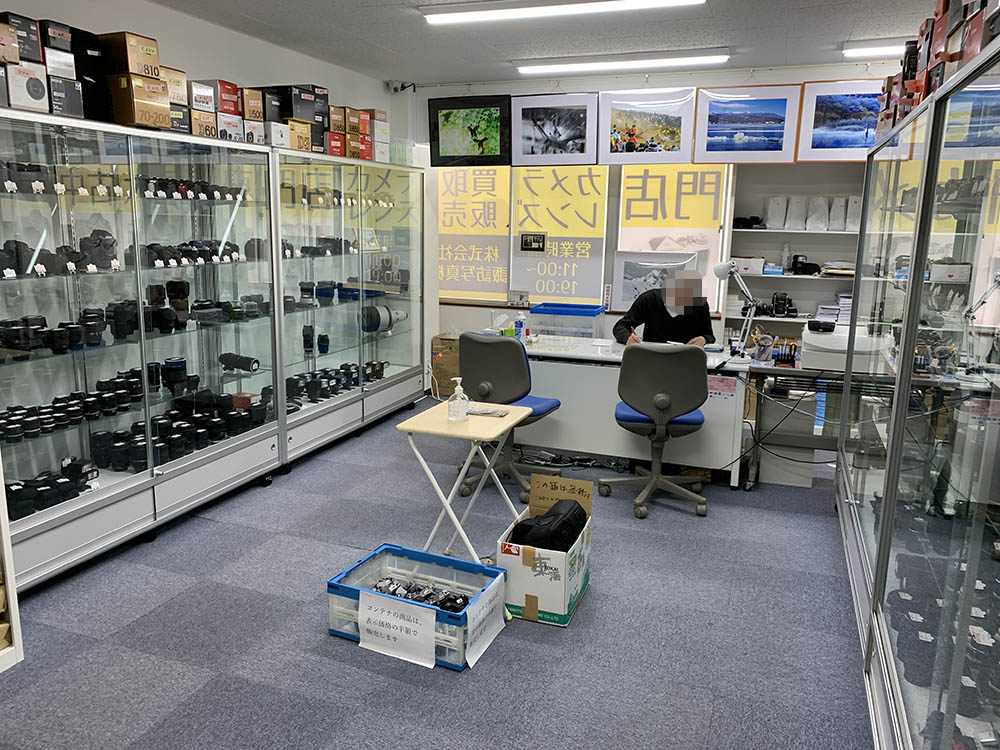
Hello, everybody! I will give you a tour around one of my favorite shops. I seldom come here in recent years due to its location being a bit inaccessible to me. Despite that I always find myself buying stuff from them each time I visit, their inventory is certainly impressive by local standards.
Introduction:
Gokurakudo (極楽堂) has been in business for some time now. The owner is known by everyone in the hobby, he could speak good English so it’s not hard for many non-Japanese speakers to communicate with him. I told him that I would make an article about the shop but it took me years to do so since I left my old job some years ago which was located close to them. It was started in celebration of everything “Contax“, from Carl Zeiss to the Japanese “Contax” brand by Yashica/Kyocera. It also specializes in screw-mount lenses from every manufacturer. They’re one of the shops that have transitioned well into the current online economy which helps a lot in the current pandemic situation.
This is shopfront, it’s difficult to miss because of the blue sign. When the shop is close, the shutter has a sign that says “Only Contax” in big, bold lettering. The shop itself is small but it is packed with goodies.
Hello, everybody! I was looking at the beer section of the local corner store and I found something new, Asahi made a new type of can where the whole top could be opened, giving you a better drinking experience since you could gulp a mouthful if you wish and also enjoy the aroma better compared to the usual style of beer cans where the hole is small. I am amazed at how they could make something good better, this made drinking their beer a lot more enjoyable. This is proof that something could be made even better when you just have the right idea going on. Today, I will show you something that was improved despite being fundamentally the same as its predecessor. You could enjoy the original way it renders photos but the experience is now made a lot better thanks to a couple of improvements in handling.
Introduction:
The Cine-Nikkor 13mm f/1.9 is an update of the original Cine-Nikkor 13mm f/1.9, it’s now bigger and the barrel is now made with an aluminum alloy and painted black instead of the all-brass barrel of the original one. I don’t know when it was sold but some people suspect that the change was made around the latter half of the 1950s around the same time the other Nikkors got the same update.
Handling is rather nice as the rings are easy to manipulate and the numbers are easier to see. The barrel itself is made from alloy so it’s light. We also begin to see Nikon starting to realize that having a standard size for filters is better and more economical for the user so the tip of the barrel doesn’t taper anymore.
Hello, everybody! After a string of stories about camera shops closing due to the pandemic and other reasons such as the owners being too-old for the business and other things I am happy to announce that a new shop has opened. It’s a good sign since it represents the collective will-power of the whole hobby. I’m happy to introduce this new shop to all of you who truly appreciate old camera equipment as we’re the keepers of this subculture and economy.
Introduction:
Suwa Camera (諏訪写真機) is a small used camera shop in Shinjuku, it’s recently opened its doors somewhere around last year. This is the reason why not a lot of people knew about this shop, including me. I used to work near this place so I’m familiar with area so it wasn’t difficult for me to find this shop.
The shop’s inventory is modest since it’s been in business for not a long time but it does have a nice inventory that will have something interesting for anyone. The price is also reasonable and not too-different from what you will find from other shops.
Hello, everybody! Do you remember the original “TRON” with Jeff Bridges? This movie has some of the earliest scenes that were rendered with CG, the rest are practical-effects and a lot of the glow used to depict wireframe in the movie were shot by employing some optical effects. The look is special, something that made the movie “legendary”. Today, I will show you something that could help you achieve that look. It will add an unnatural glow to your photos if you know how to trigger it. Read this article to know what this lens is.
Introduction:
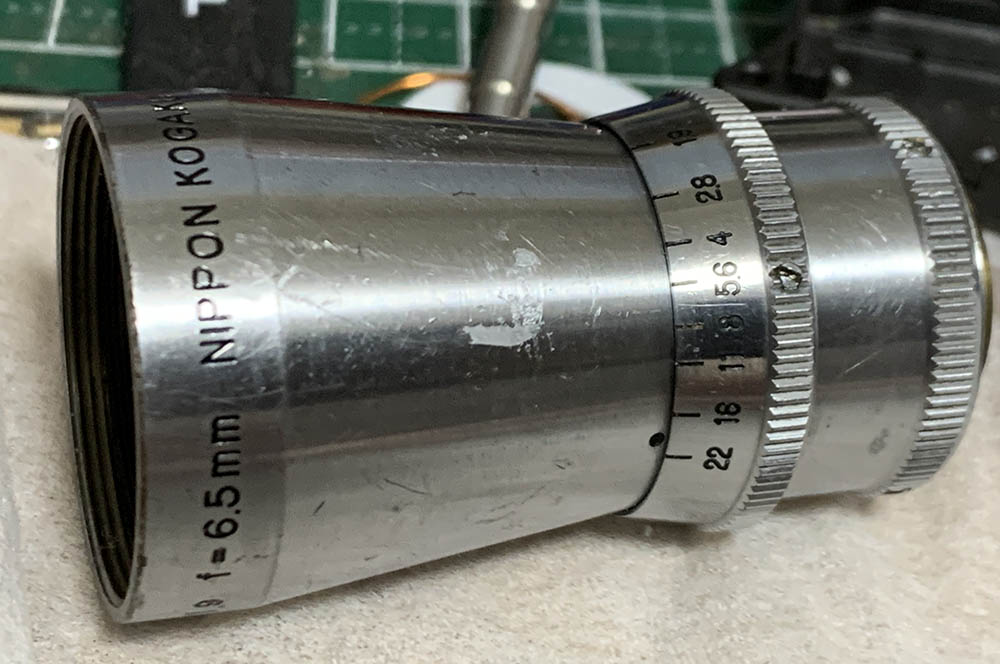
The Cine-Nikkor 6.5mm f/1.9 underwent a small upgrade to the black-barreled version featured in this article. I do not know when the change happened but many people assume it to be around the latter-half of the 1950s when Nikon did a program to upgrade the look and materials of their lenses. This not only resulted in similar lenses with different color and finishes but the exterior somewhat look different, too. In most cases the material used is also different. The heavier all-brass construction of older Nikkors were dropped in favor of using lighter alloys. The optics remained the same and I couldn’t think of any Nikkor in this period that had their optical formula changed at the same time the barrel had an upgrade.
Large parts of the barrel were milled from alloy, making it a bit lighter. Since it’s a fixed-focus lens you manipulate what is in-focus by adjusting the aperture. This all sounds simple but it can be difficult to predict your depth-of-field since it has no scale to indicate what’s in-focus. This isn’t much of a problem when using this with a Pentax Q series camera, it is rather frustrating when shooting with an 8mm movie camera specially if what you intend to focus is close to you. It’s durable, the all-metal construction ensures that it will take plenty of punishment when used in the field.
Hello, everybody! I was watching a video about “Hercules beetles” (Dynastes hercules). They’re the largest of all the beetles, certainly a little monster. While many of use see beetles as little creatures this one certainly isn’t little at all, the carapace alone is huge and they can weigh more than some small mammals. Despite that, I find them cute because it’s fascinating to observe how the largest beetle species go about their lives. Today, I’m going to show you a little giant, it is certainly the largest of its kind and definitely the heaviest. Read this article to find out what this is.
Introduction:
The Cine-Nikkor 38mm f/1.9 was sold around the mid-1950s, I do not know the exact dates but these were sold along with Uryu Seiki’s then-popular Cinemax-8 series of cameras which debuted around 1953. This is Nikon’s first telephoto D-mount lens, part of a trinity comprising the Cine-Nikkor 6.5 f/1.9 and the Cine-Nikkor 13mm f/1.9. Its field-of-view is the equivalent of a 210mm lens for the 35mm format and despite having a “fast” f/1.9 maximum aperture its effective speed is actually much slower which is as expected since it was made for standard 8mm, a very small format compared to 35mm. It was a popular lens so these aren’t rare at all but not really common these days since people found a new use for D-mount lenses with the advent of the Pentax Q series of miniature mirrorless cameras.
It has an impressive all-brass construction which makes this feel dense when held. You could focus quite close with this, about 2ft according to the scales. This allows you to take photos of small things which is quite handy.
Hello, everybody! Do you remember the show “Small Wonder“? I loved that show when I was younger, life was a simple back then and shows like that was enough to entertain anybody. We weren’t as fussy back then and we just accepted a lot of things. I guess that’s just how things were back then. I don’t think I’ve lost that since I am still satisfied with many things in life today despite the inconvenience. Today, I will show you something small. It’s really a “small-wonder” and I am also entertained by what I get from it despite not technically being excellent. It was made for a different time if you think about it, a time where things were much simpler than what we had 40 years ago. Read this article to see what this thing is.
Introduction:
The Cine-Nikkor 13mm f/1.9 was sold around 1953 to an unknown date, it’s notable for being sold with the Japan’s first 8mm motion-picture camera. It was replaced by the black-barreled Cine-Nikkor 13mm f/1.9 which is more common. It is an interesting lens with a lot of history behind it but not a lot of information could be found since the market at that time was dominated by European brands so there’s not a lot of literature left for us to reference from. What I do know is it was sold together with the Cinemax 8A made by Uryu Seiki in 1953 as a kit until the latter began to make lenses of their own. It was common for many Japanese manufacturers to include Nippon Kogaku lenses with their cameras at the time until they get the ability to design and manufacture their own optics, one example of this is Canon.
It’s all-metal, which makes this feel dense when held in your hand. It’s amazing how much detail went into building this little gem, the beautiful engravings are informative but difficult to see thanks to the shiny chrome-finish. It’s so tiny, the rings can be hard to recognize at times and you could be turning the wrong one if you’re not looking at it.. The front is recessed so a hood isn’t necessary.
Hello, everybody! Do you know about the “vintage-look”? It’s something that many people use these days to describe how a lens renders a scene. This term mostly gets thrown-around when talking about older lenses because they were not made to be optically-perfect. This was done either deliberately or simply because the technology of that time was not able to accurately calculate rays as fast as the engineers wanted or the manufacturing techniques just wasn’t there yet. While this trait is considered outdated by many people there’s a small group who seek these traits, mainly people who are into shooting movies. It can be used for storytelling and other creative pursuits. Experts say that your taste for the “vintage-look” increases as the adjectives used to describe your coffee gets longer. I beg to disagree because I am merely a Nescafé drinker but I appreciate a good lens with the said trait. Today, I am going to show you one such lens. It produces imperfect photos which can lead to expanded creative expressions. Read this article to know what this is.
Introduction:
The Cine-Nikkor 6.5mm f/1.9 was introduced in the 1950s to capitalize on the 8mm movie cameras boom of that time. I do not know much about this lens since there aren’t many literatures about this. While 6.5mm sounds wide if you are coming from a standard 35mm perspective it’s actually considered to be rather moderate in standard 8mm. You’ll get an equivalent of about 36.5mm in terms of field-of-view with a full-frame (35mm) camera. The maximum aperture also sounds fast but it’s actually a lot slower than that. This is the reason why f/1.2 or even f/1.0 ones were common for the standard 8mm format but even with those speeds they won’t mean much when compared to larger lenses made for a bigger format such as standard 35mm.
The styling is similar to many European lenses of its class along with the decision to make it a fixed-focus lens. The lens is quite dense due to its brass parts and large front group. The aperture-range is from f/1.9 to f/22 and you use that for manipulating your focus via the depth-of-field. This is trivial since it’s considered to be a wide-angle lens so getting the scene in-focus should theoretically be easy. Stopping it down to f/8 will allow you to get most of your scene in-focus.
Hello, everybody! It’s spring now and it’s time for shopping. I rarely travel far lately due to the pandemic but if I do get to Ueno I always visit a particular shop which I will introduce to you in this article. They have a following because of the products they sell and to be specific, the quality of their merchandize. This is important if you want worry-free use, not all camera-lovers know how to repair old gear anyway.
Introduction:
Chikuka Camera (千曲カメラ) is one of the oldest shop in town which opened its doors in 1946. The shop is know for a lot of things such as the quality of their goods, the friendly and knowledgeable staff and what they have in the shop. It is not know for selling at bargain-level prices but their merchandize are all in great shape. If you want to buy a camera and just use it right out of the shop then this shop should give you that.
The shopfront is hard-to-miss if you’re in the area. Just like what the print at the awning says, they’re passionate about imported brands so this place should be on your list if you are looking for nondomestic cameras in Tokyo.
Hello, everybody! Let’s talk about something more simple. I have been collecting Cine-Nikkors lately and they’ve been all adjusted so I could focus properly to infinity. I will show you how I create my shims in this article.
Introduction:
Shooting with different systems sometimes require different methods to adjust a lens. The methods are vary from easy to difficult and at rare times even impossible depending on the situation. I’ll show you one method I use to achieve this and teach you how I make them. While making shims to adjust a lens’ focus is universal I’ll concentrate on using them to adjust the tiny D-mount lenses in this article and I’ll stay within that context. Do note that what you are about to see here also applies to other applications outside of adjust a lens’ focus and I will leave that to your imagination.
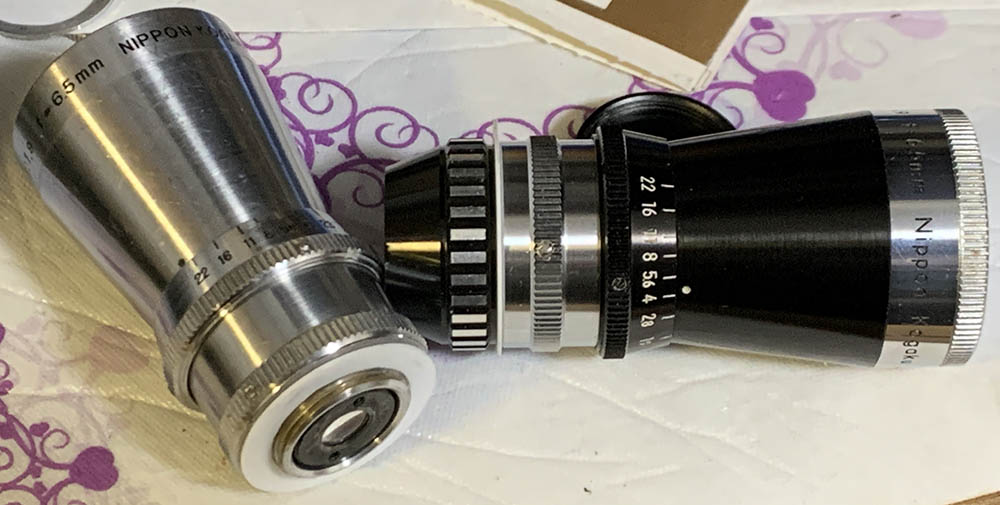
Here are my 2 Cine-Nikkor 6.5mm f/1.9 beauties. Both are fixed-focus lenses which means that there’s no way I’m able to adjust their focus apart from adding shims. Despite being identical optically and and barrels being similar in almost every manner these require shims that have different height with a difference of less than 0.1mm. You’ll have to make custom shims for every lens you own even if they’re of the same model and variation. Do note that the black one has a large cap at the rear and a front cap so it looks different from the earlier silver one. It’s important to note that the sizes of their accessory ring is different so they couldn’t share the same accessories such as filters and caps.
Hello, everybody! I’m always amazed at how smart my little girl is. She’s somewhat of a mascot when I go shopping for cameras and other junk since she occasionally tags-along, people associate her with me. The shopkeepers know her because they’ve been seeing her since she was a little baby, only a few-months-old. She sings a lot of songs, can draw quite well and very observant. It’s like she’s a teen in a preschooler’s body. Many small things amaze us, phones, bugs and other things. Despite being tiny they have a lot of things going on. Today, I will show you something small but size can be deceiving because this one has many features that many of its bigger contemporaries don’t. Read the whole article to know what this is.
Introduction:
The Pentax Q10 was sold in 2012, replacing the Pentax Q. The Pentax Q10 was replaced by the Pentax Q7 under a year later. I have always wanted to buy this but I did not want to divert my focus from Nikon at that time. It’s excellent and unique, the whole system punches above its weight in terms of features but sadly the whole series only lasted for a few years with only 4 models made. That made it so appealing back then but that wasn’t enough to make me part with my money. Fast-forward to 2021, these are now cheap and I also have a new alibi to purchase one – vintage Cine-Nikkors. The Pentax Q and the Pentax Q10 are your best options if shooting with D-mount lenses since they have sensors that’s closer to the size of 8mm (standard) than other interchangeable lens mirrorless cameras and you could get really close to the sensor with it just like what the D-mount lenses require since they’re made for 8mm. If you ever recall using one you will remember how close the rear of the lens is to the aperture of the movie camera, that is just about 9mm or so, maybe even less.
This is the tiniest setup I have, the Cine-Nikkor 13mm f/1.9 is really tiny but it compliments the Pentax Q10 well and the retro-look of the camera makes this even look more appealing. Using manual lenses with the Pentax Q10 is great since its features are comparable to that of many higher-end models or even surpass them. Features such as focusing-aids, manual-lens data input are very helpful. While the in-body shake reduction (SR) feature is nice I won’t use that feature much and I’ll explain that to you in this article.
Help support this site by donating to richardHaw888@gmail.com over at Paypal! If you want to buy me a beer or a roll of film then that would be great,too!